Highlights

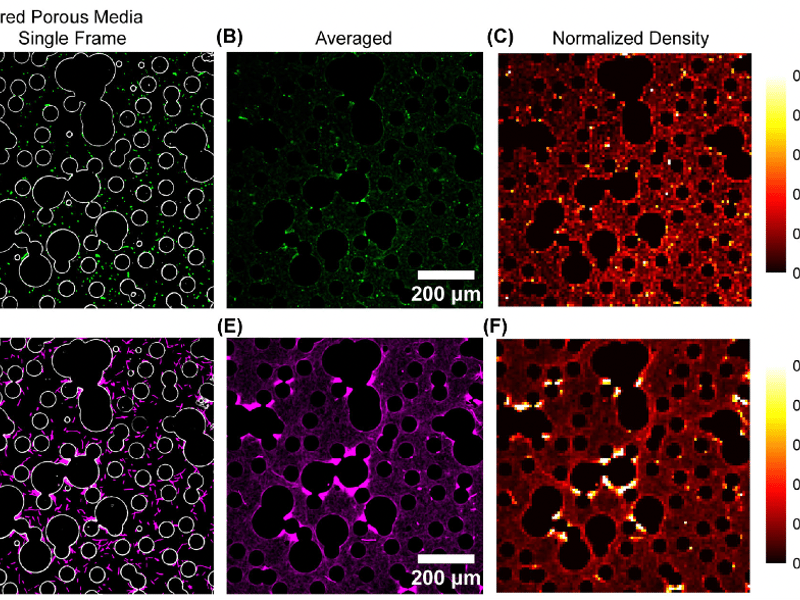
Top row (A-C): short bacteria (~4 µm) in a disordered porous medium distribute almost uniformly. Bottom row (D-F): the same strain induced to elongate (~10 µm) accumulates sharply along pillar surfaces, with the density map (F) showing bright bands at concave dead-end regions where long cells become stuck. The contrast suggests a passive filter that sorts cells by length and shape.
Jun 8, 2026
University of Pennsylvania

Bacterial Cell Length Sets Who Gets Through and Who Gets Stuck in a Porous Maze

Arnold J. T. M. Mathijssen and Ran Tao, University of Pennsylvani
Penn MRSEC Seed researchers Mathijssen and Tao showed that the length of a swimming bacterium and the geometry of the porous environment around it jointly determine whether the cell traverses or becomes trapped, and used that coupling to propose a passive physical mechanism for sorting antimicrobial-resistant bacteria from drug-affected ones.
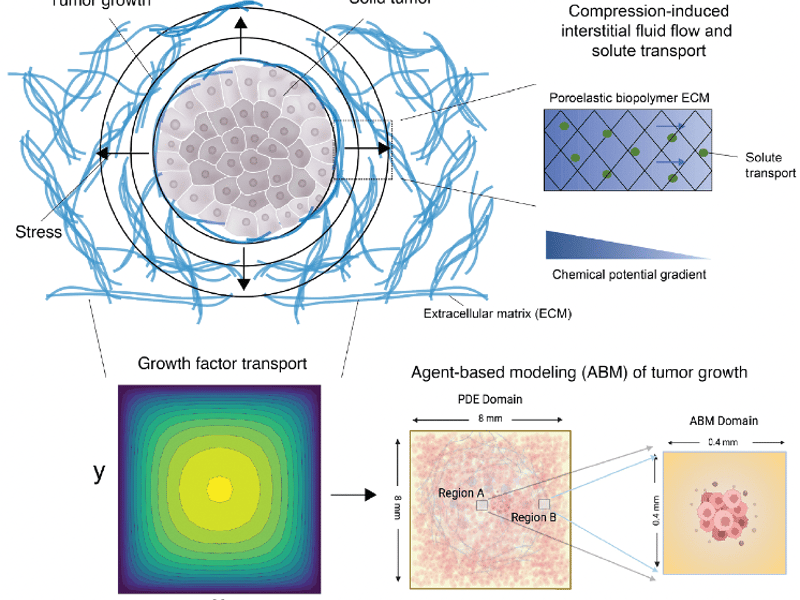
Integrated multiscale framework: tumor expansion compresses the porous biopolymer ECM (center, blue mesh) and drives interstitial fluid outflow (top right), which sets a chemical-potential gradient and a heterogeneous growth-factor distribution (bottom left). Those concentration fields feed an agent-based tumor-growth simulation (bottom right) that couples matrix mechanics to cell proliferation.
Jun 8, 2026
University of Pennsylvania

Fluid Squeezed Through a Tumor's Matrix Shapes How It Grows: A Poroelastic Multiscale Model

Kyle Vining, Prashant K. Purohit, Paul Janmey, University of Pennsylvania
Penn MRSEC Seed researchers Vining and Purohit, with Radhakrishnan, showed that under large compressive strains characteristic of growing tumors, water flow through the porous extracellular matrix dominates stress relaxation, alters growth-factor transport, and reshapes how a tumor proliferates over physiological timescales.
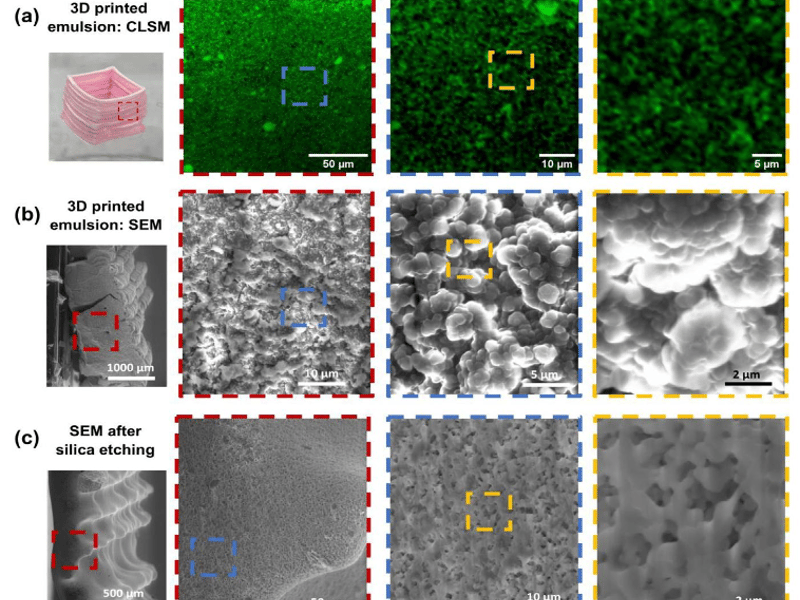
Multi-scale imaging of a 3D-printed bicontinuous emulsion gel, zooming in left to right (red → blue → yellow boxes). (a) Confocal fluorescence: green = cured polymer (oil phase), black = pores (water phase). (b) SEM cross-section: polymer channels coated with the silica nanoparticles that locked the oil-water interface. (c) After silica is etched away, the interpenetrating polymer-pore network is exposed.
Jun 8, 2026
University of Pennsylvania

3D Printing Interpenetrating Polymer–Pore Networks: Bicontinuous Emulsion Gels in Arbitrary Shapes

Kathleen Stebe and Daeyeon Lee, University of Pennsylvania
Penn MRSEC researchers Stebe and Lee developed a 3D-printable ink that, after extrusion, spontaneously phase-separates into a bicontinuous oil-water emulsion stabilized by fumed silica nanoparticles, locking in two interpenetrating channels with sub-micron domains while the printed object holds an arbitrary centimeter-scale shape.
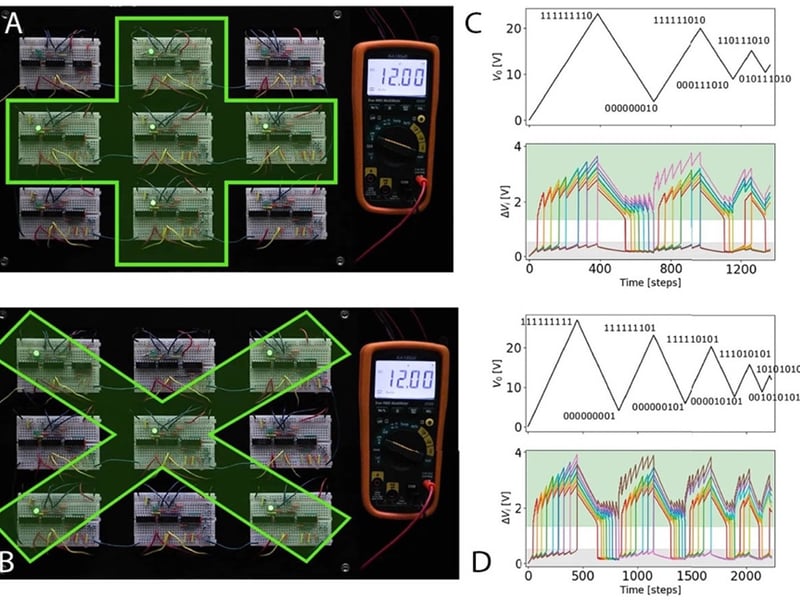
A nine-edge bistable circuit network displays two distinct memory patterns (“+” in c, “×” in d) under the same 12 V global drive; the right panels (e, f) track the drive history V₀ and the individual edge voltages ΔVᵢ, with binary labels marking the network state at each turning point
Jun 8, 2026
University of Pennsylvania

Tunable Bistable Networks: A Programmable Platform for Flow-Network Memory

Douglas Durian and Eleni Katifori, University of Pennsylvania
Penn MRSEC researchers Durian and Katifori built a network of custom bistable electronic elements whose pattern of edge voltages records the history of how the network was driven, inspired by the multistable flow behavior seen in plant vasculature.
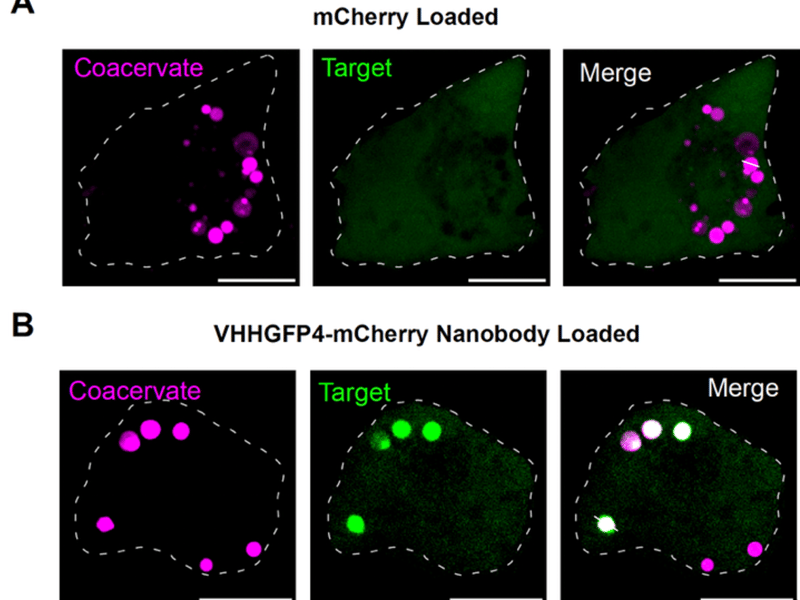
Peptide coacervates loaded with the VHHGFP4 nanobody recruit a cytosolic GFP target inside cells. Top row: coacervates loaded with mCherry alone (no nanobody) appear as magenta particles, and the GFP target remains diffuse in the cytosol (no green signal at particles). Bottom row: coacervates loaded with the VHHGFP4–mCherry nanobody concentrate GFP onto the particle surface, producing colocalized magenta + green (white in the merge). Scale bars 10 µm.
Jun 8, 2026
University of Pennsylvania

Designer Peptide Coacervates Delivered to Cells Act as Synthetic Interaction Hubs and Degradosomes

Matthew Good, David Chenoweth, and Amish Patel, University of Pennsylvania
Penn MRSEC researchers Good, Chenoweth, and Patel designed short disordered peptides that assemble into stable, gel-phase coacervate particles, loaded them with proteins of interest, and delivered them into living cells without any gene transfer, where the particles act as designer biochemical compartments that capture and degrade native target proteins.
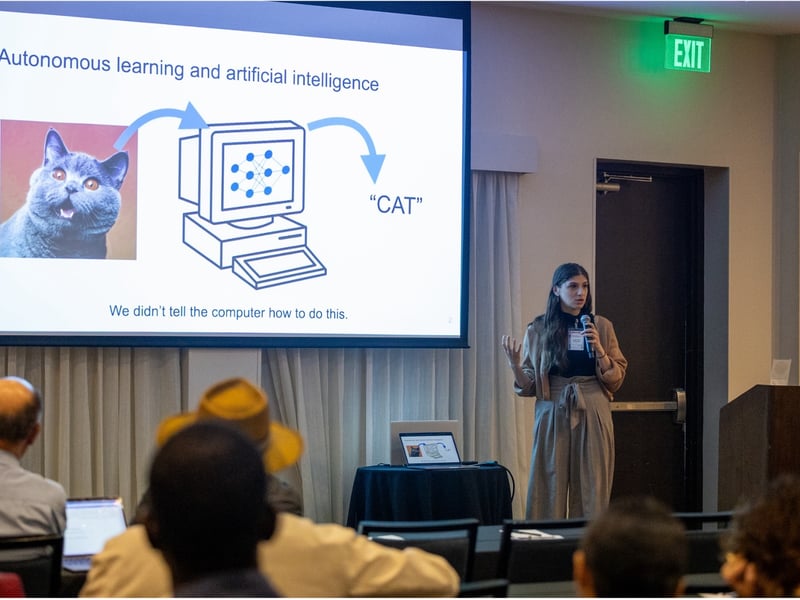
Lauren Altman (postdoc, Liu group) presenting Physics-Based Autonomous Learning Metamaterials
Jun 8, 2026
University of Pennsylvania

PREM + Penn NRT: Partnership in Artificial Intelligence & Autonomous Experimentation

Ashley Wallace, Chinedum Osuji, Eric Stach, University of Pennsylvania Idalia Ramos, University of Puerto Rico, Humacao
The 13th Annual PREM Symposium took place in San Juan, PR and focused on artificial intelligence and autonomous experimentation. The day consisted of 5 talks from Penn PD/GS and 33 poster presentations from UPR students, which served as an opportunity for presenters to not only further develop their science communication skills but to also provide participant with a platform to showcase the amazing work being conducted within the collaboration.
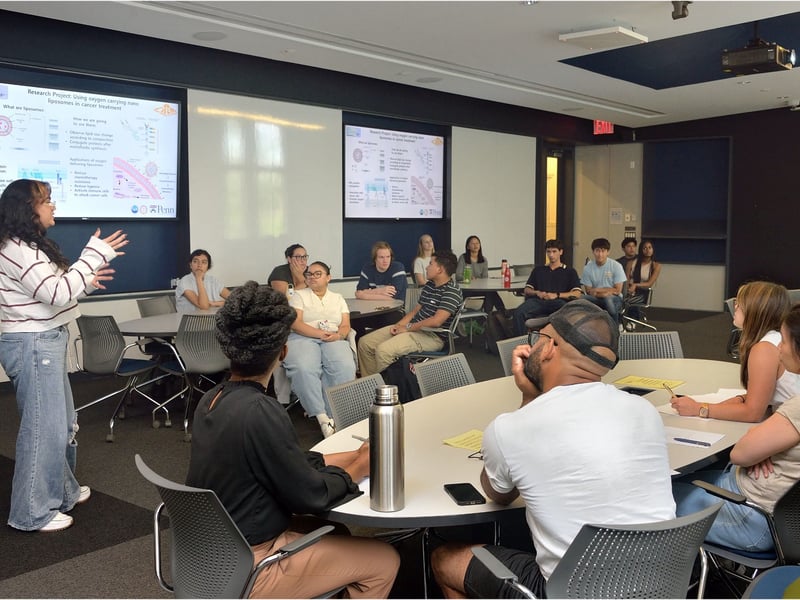
LRSM REU student presenting their research to RET teachers, graduate students, CPI REU students, and CHARM REU students.
Jun 8, 2026
University of Pennsylvania

REU: Cross-Institutional Summer Research Showcase

Mark Licurse & Ashley Wallace, University of Pennsylvania
In a collaborative effort between the University of Pennsylvania MRSEC (LRSM), the University of Delaware MRSEC (CHARM), and the University of Delaware Energy Frontier Research Center (CPI), 36 summer undergraduate research scholars engaged in a day designed to encourage connection and science exploration through shared experiences across MRSECs. 
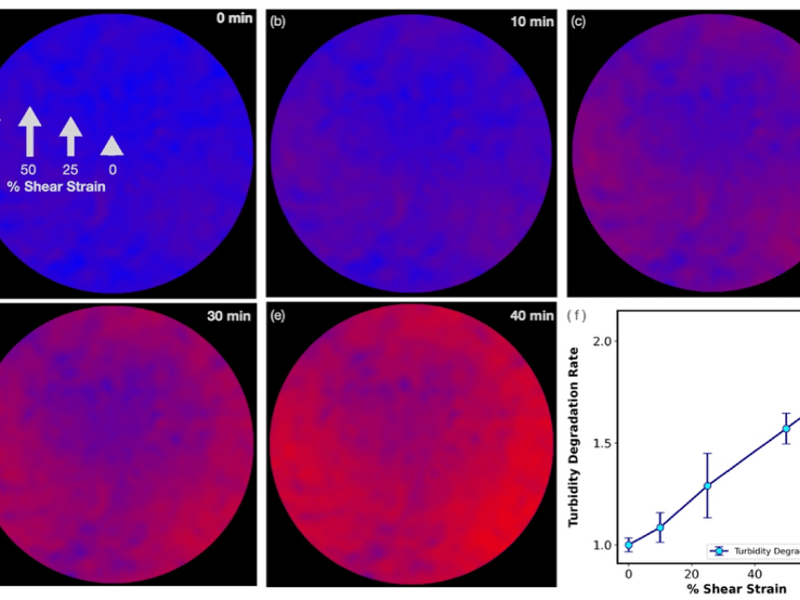
A circular fibrin gel viewed from below as plasmin degrades it under radially varying shear strain (zero at center, 75% at edge); the outer ring turns red (degraded) by 30–40 min while the strain-free center remains blue (intact). Panel f: turbidity decay rate rises roughly linearly with shear strain.
Jun 8, 2026
University of Pennsylvania

Fibrin Networks as Mechanoresponsive Substrates: Strain Tunes Both Crosslinking and Breakdown

Paul Janmey, University of Pennsylvania
Penn MRSEC researcher Janmey and colleagues showed that mechanical shear strain on fibrin gels — the protein scaffolding that holds a blood clot together — speeds up both of fibrin's natural remodeling enzymes: Factor XIIIa, which covalently crosslinks the fibers, and plasmin, which proteolytically degrades them.
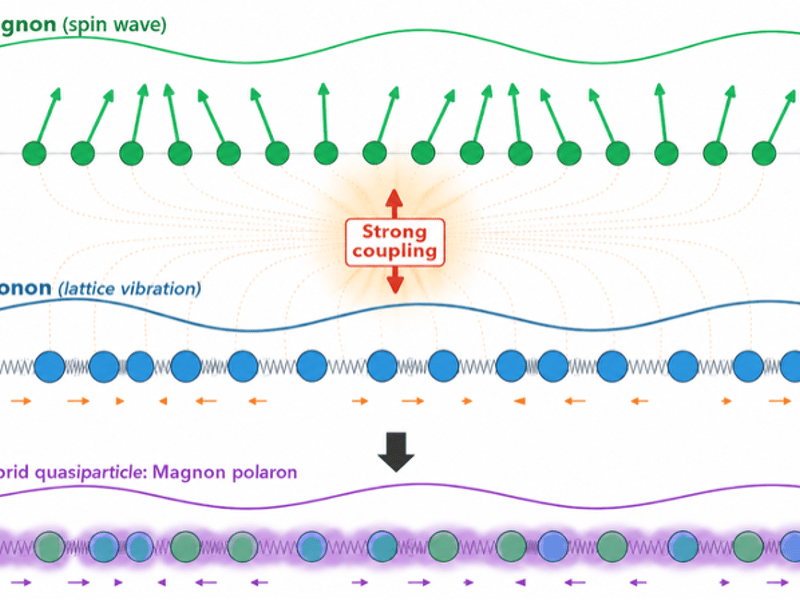
Magnon (top) and phonon (bottom) on the same lattice; their coupling produces hybridized quasiparticles (magnon polarons), e.g. in monolayer CrI3.
Jun 1, 2026
University of Wisconsin - Madison

Efficient method for computing magnon-phonon coupling from first-principles

Yuan Ping, University of Wisconsin-Madison
Spin waves called magnons are an emerging way to carry information with far less energy than today’s electronics and to link qubits in future quantum technologies. How long that information survives is limited by the spin waves’ coupling to atomic vibrations, especially at room temperature.
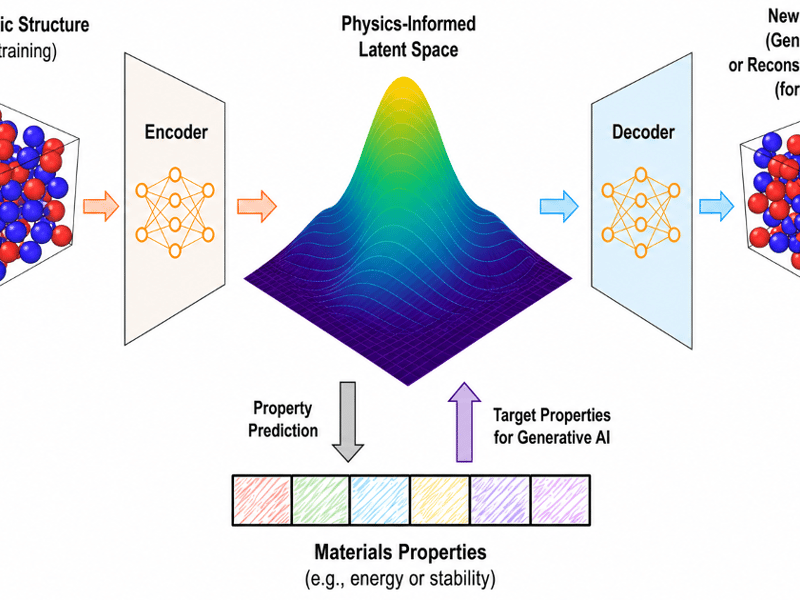
GlassVAE – a physics-aware generative AI model for glasses
Jun 1, 2026
University of Wisconsin - Madison

Physics-Aware Generative AI for Metallic Glasses

Bu Wang, Dane Morgan, University of Wisconsin-Madison

Wisconsin MRSEC IRG 1 developed a new generative AI model for metallic glasses, called GlassVAE. The model is based on ideas similar to ChatGPT, but adapted to describe the complex atomic structures of glasses.

Showing 1 to 10 of 1451