Outcome:
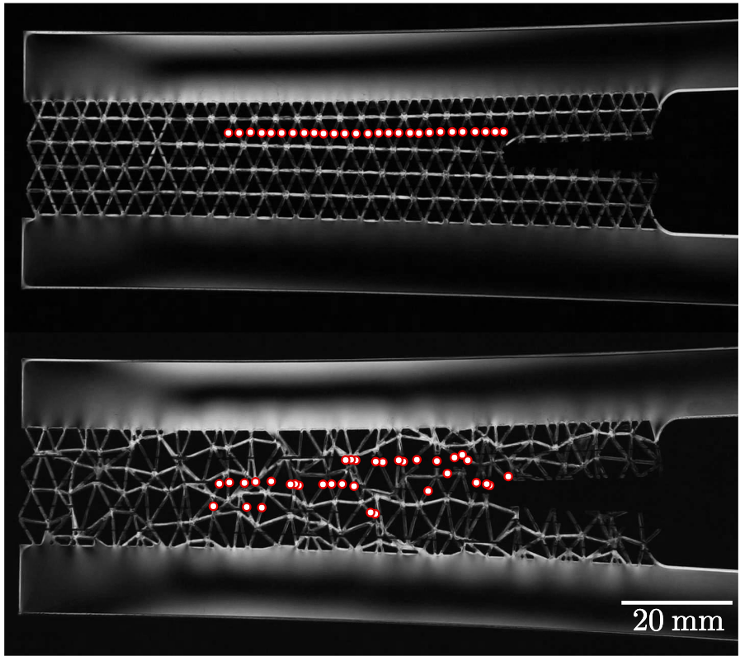
Researchers have demonstrated that introducing geometric disorder in mechanical metamaterials leads to distributed damage during failure, resulting in significantly enhanced fracture toughness with minimal loss of strength. This finding challenges the traditional reliance on periodic unit cell geometries in architected materials.
Impact and Benefits:
This research provides a new approach to designing mechanical metamaterials with enhanced fracture toughness. The study opens possibilities for creating materials that are more damage-tolerant by leveraging disorder. These materials have various applications, including structural materials for aerospace and vehicles, protective gear, and biomedical devices.
Explanation:
Geometric disorder was introduced into regular triangular lattices by perturbing nodal locations, and the impact on damage distribution and toughness was investigated. Improvements in toughness with increasing disorder, up to a limit, were observed in computational simulations and mechancis experiments. A mechanics-based scaling law that relates toughness to local changes in strength and the number of fracture events was shown to predict the changes in toughness with disorder.
 Download
Disorder enhances the fracture toughness of 2D mechanical metamaterials

UPENN Materials Research Science and Engineering Centers
The LRSM at UPENN is a center of excellence for materials research and education. It facilitates collaboration between researchers from different disciplines including physics, chemistry, engineering, and biology to advance transformative scientific projects and solve societal challenges.