Outcome:
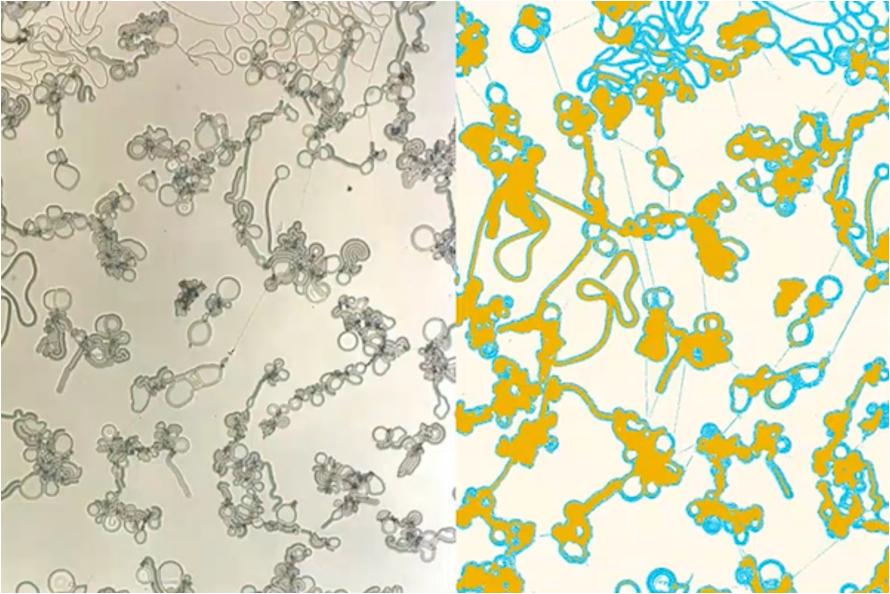
Scientists discovered a unique self-assembling network structure that forms when certain liquid crystal materials separate. These networks spontaneously create intricate patterns of filaments and disc-shaped structures through a series of physical transformations driven by competing forces.
Impact and Benefits:
This discovery reveals a new mechanism for creating complex, organized structures through simple cooling processes. Understanding these self-assembling networks could lead to innovative approaches for designing new materials with tunable properties, applicable to industries ranging from filtration membranes to optical components and biological interfaces.
Explanation:
When cooling a mixture of liquid crystal molecules and solvent, the liquid crystals don't form typical spherical droplets. Instead, they create elongated filaments that grow, buckle, and collapse into interconnected networks. This behavior is driven by a competition between elastic forces within the liquid crystal and surface tension, creating dynamic self-driven assembly that mimics aspects of living systems.
 Download
Spontaneous assembly of condensate networks during the demixing of structured fluids

UPENN Materials Research Science and Engineering Centers
The LRSM at UPENN is a center of excellence for materials research and education. It facilitates collaboration between researchers from different disciplines including physics, chemistry, engineering, and biology to advance transformative scientific projects and solve societal challenges.