Bismuthates like Ba1-xKxBiO3 (BKBO) host high-Tc superconductivity via doping a charge-density-wave insulating phase.
While electron-phonon (𝑒-ph) coupling is proposed to play a key role, the bismuthate normal state is anomalous and poorly understood.
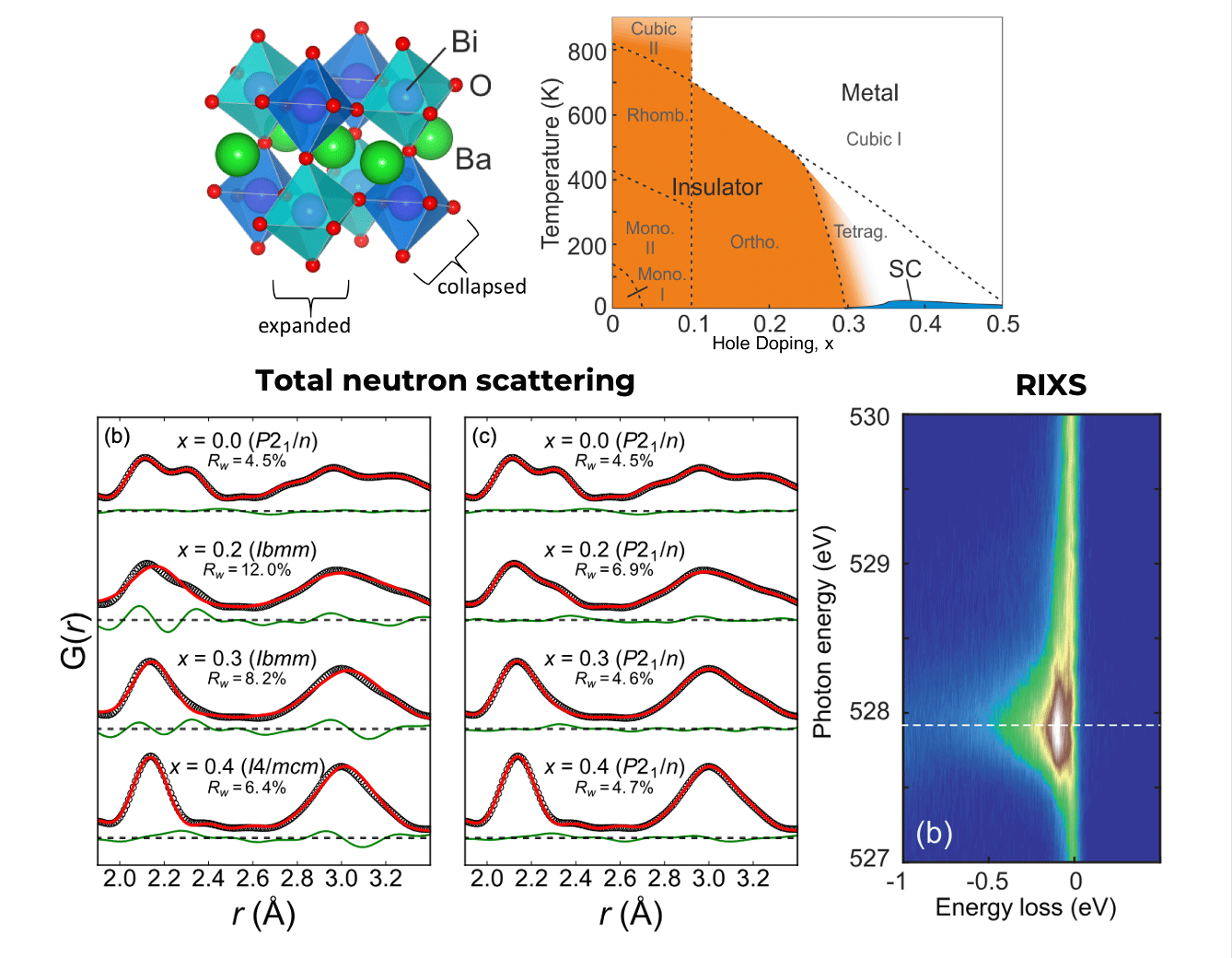
Researchers from IRGs 1, 2, and the Paul-Sherre Institute combined resonant inelastic x-ray and neutron total scattering techniques with advanced modeling to address this problem.
The team found that the doped system hosts short-range structural distortions of the lattice with a sizable 𝑒-ph coupling deep into the material’s metallic phase.
These findings demonstrate that BKBO’s metallic phase is an anomalous and highly sought after bipolaronic liquid.
 Download
Persistence of small polarons into the superconducting doping range of Ba1−xKxBiO3

Center for Advanced Materials & Manufacturing
CAMM at UT Knoxville, focuses on the exploration, discovery, and design of new materials with properties of critical societal importance for energy, transport, and security advancements.