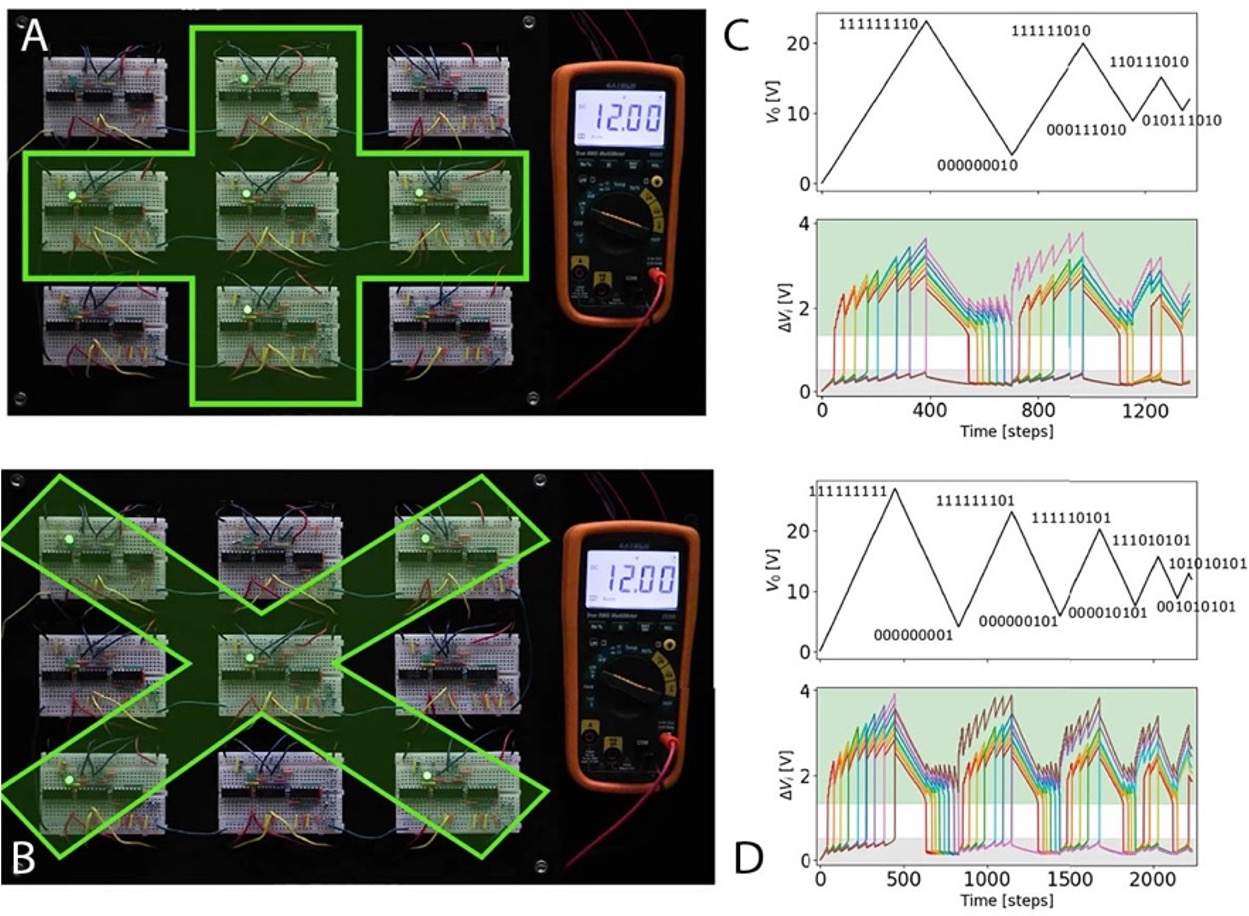
Outcomes: Penn MRSEC researchers Durian and Katifori built a network of custom bistable electronic elements whose pattern of edge voltages records the history of how the network was driven, inspired by the multistable flow behavior seen in plant vasculature.
Impacts and Benefits: In addition to explicitly non-interacting non-linear elements, the same circuit can implement arbitrary interactions between edges, including anti-cooperative coupling that produces antiferromagnetic-like ordering. The platform is a substrate for analog networks that compute, oscillate, or adapt without centralized control, and a testbed for memory phenomena in vasculature and other biological flow networks that resist direct measurement.
Explanation: Durian and Katifori built an electronic network of bistable resistors (devices that exploit negative differential resistance). Each resistor's current-voltage curve could be independently tuned via two parameters (a gate voltage and a parallel resistance), giving precise control over when and how each element switches between its two stable states. By connecting multiple such devices in series and driving the whole network with a single global voltage, they showed that the network could store complex "memory states”, specific patterns of on/off voltages across elements, that depend entirely on the history of that global drive. They also observed and explained avalanching behavior, where one element switching triggers cascading switches in others.
 Download
Collective behavior and memory states in flow networks with tunable bistability

UPENN Materials Research Science and Engineering Centers
The LRSM at UPENN is a center of excellence for materials research and education. It facilitates collaboration between researchers from different disciplines including physics, chemistry, engineering, and biology to advance transformative scientific projects and solve societal challenges.