Outcomes: Penn MRSEC Seed researchers Vining and Purohit, with Radhakrishnan, showed that under large compressive strains characteristic of growing tumors, water flow through the porous extracellular matrix dominates stress relaxation, alters growth-factor transport, and reshapes how a tumor proliferates over physiological timescales.
Impacts and Benefits: Stiffness and viscoelasticity of the tumor microenvironment have been studied extensively, but compression-driven interstitial flow at large strains and long timescales has been overlooked. The work identifies this flow as a distinct, tunable control parameter for tumor progression, with implications for drug delivery, for the design of biomaterial test beds that capture in-vivo transport conditions, and for therapeutic strategies that target the mechanical microenvironment rather than the cancer cell directly.
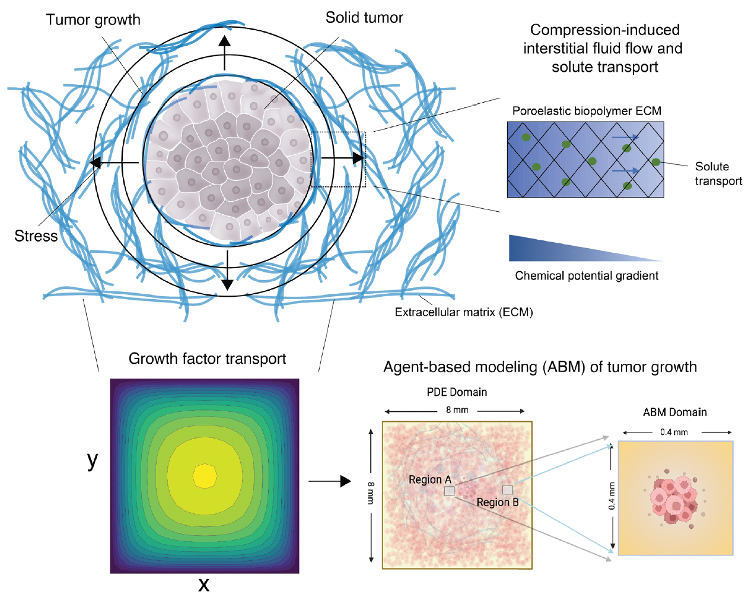
Explanation: Tumors compress the surrounding extracellular matrix as they grow. The team built ionically and ionically/covalently crosslinked alginate hydrogels as a tunable porous matrix and measured their response to stepwise large-strain (up to 40%) axial compression. Stress relaxation was dominated not by polymer reorganization but by poroelastic outflow of water through the network's pores, with measured volumetric flux fitting Darcy's law and matching in-vivo interstitial flow speeds. Continuum-mechanics modeling then computed chemical-potential gradients of water under compression, and an advection-diffusion framework converted those gradients into growth-factor transport. A dimensionless Péclet number, set by the ratio of convective to diffusive transport, served as the bridge between the mechanical experiment and an agent-based simulation of tumor cell proliferation. Across physiologically relevant Pécletnumbers, mechanically driven interstitial flow produced strongly heterogeneous growth-factor distributions and substantially different tumor-load trajectories between central and peripheral regions, identifying poroelastic transport as a standalone regulator of tumor growth.
 Download
Modeling tumor transport and growth with poroelastic biopolymer networks

UPENN Materials Research Science and Engineering Centers
The LRSM at UPENN is a center of excellence for materials research and education. It facilitates collaboration between researchers from different disciplines including physics, chemistry, engineering, and biology to advance transformative scientific projects and solve societal challenges.