Outcomes: Penn MRSEC Seed researchers Mathijssen and Tao showed that the length of a swimming bacterium and the geometry of the porous environment around it jointly determine whether the cell traverses or becomes trapped, and used that coupling to propose a passive physical mechanism for sorting antimicrobial-resistant bacteria from drug-affected ones.
Impacts and Benefits: Bacteria live in porous media — soils, sediments, host tissues, the gut lumen — where geometry shapes how infection, biofilms, and bioremediation play out, and where antibiotic exposure often forces susceptible cells into a filamentous shape that resistant cells avoid. The team's result identifies pore geometry as a tunable design knob for separating resistant from susceptible populations without chemistry, with potential applications in diagnostic devices, biofilm control, and microbial ecology.
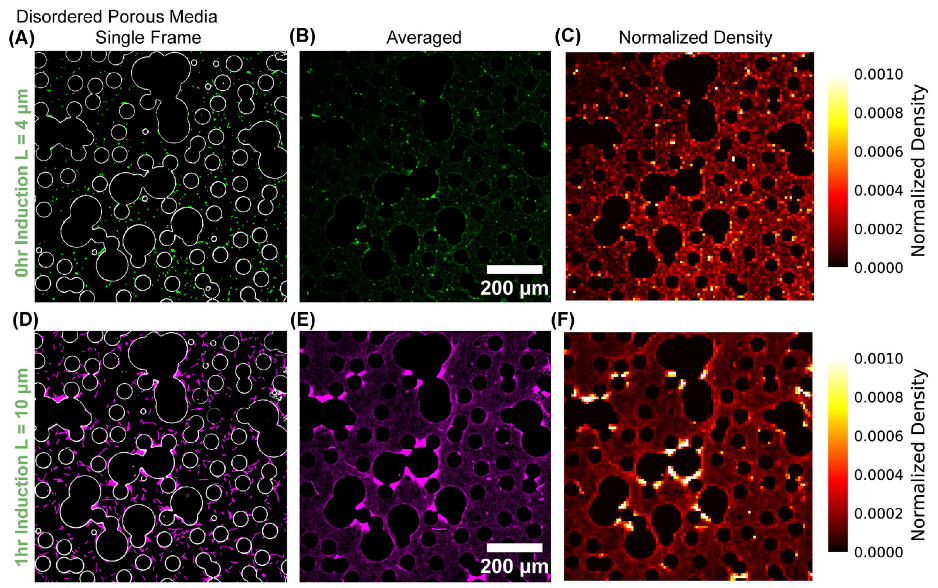
Explanation: The team engineered Escherichia coli with an inducible cell-division switch so that pulses of arabinose lengthen cells from ~4 µm to ~16 µm without altering their swimming machinery. Single-cell tracking inside two-dimensional microfluidic devices that mimic either an ordered lattice of pillars or a disordered pillar arrangement revealed a sharp reversal of behavior. In the ordered geometry, long cells outperformed short ones: they followed straighter paths, reoriented less often, showed higher directional persistence, and explored larger areas, because the channel walls suppress tumbling for elongated bodies. In the disordered geometry, the same long cells failed: they wedged into dead-end concave regions and accumulated there as bright bands in density maps, while short cells dispersed nearly uniformly. The asymmetry suggests a passive sorting principle: a designed porous medium with the right disorder statistics filters elongated, drug-affected cells out of a mixed population and lets compact resistant cells pass.
 Download
Selective Trapping of Bacteria in Porous Media by Cell Length

UPENN Materials Research Science and Engineering Centers
The LRSM at UPENN is a center of excellence for materials research and education. It facilitates collaboration between researchers from different disciplines including physics, chemistry, engineering, and biology to advance transformative scientific projects and solve societal challenges.