Highlights
May 20, 2019
New York University
Freely Jointed Polymers Made of Droplets
Angus McMullen, Miranda Holmes-Cerfon, Francesco Sciortino, Alexander Y. Grosberg, and Jasna Brujic, New York University
Here, we control the valence of DNA-functionalized emulsion droplets to make flexible colloidal polymers. We examine their conformational statistics to show that they are freely jointed. We demonstrate that their end-to-end length scales with the number of bonds in agreement with 2D Flory theory, and that their diffusion follows the Zimm model.
May 20, 2019
New York University
A Fully Voltage-Controlled Spin Logic Device
Rakheja, Flatté and Kent, New York University
An important goal in electronics is to reduce power use without sacrificing performance. In spintronics this can be accomplished by increasing the rate of charge to spin conversion. We show that one of the most efficient means of converting charge to spin information uses a topological insulator and voltages instead of currents.
May 20, 2019
Columbia University in the City of New York
Hierarchical Coherent Phonons
Xiaoyang Zhu, Xavier Roy, Colin Nuckolls, Center for Precision Assembly of Superstratic and Superatomic Solids
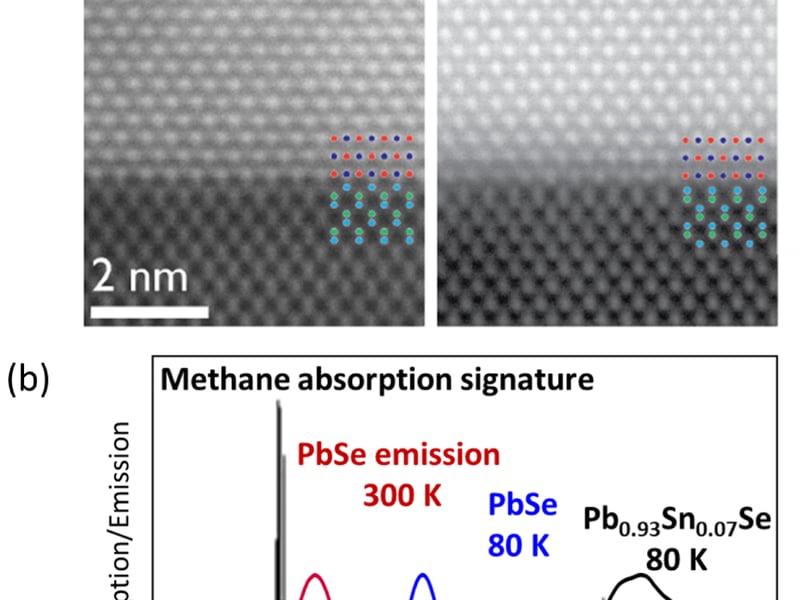
The coupling of phonons to electrons, excitons and other phonons plays a defining role in material properties, including charge and energy transport, light emission, and superconductivity. In atomic solids such as Si or GaAs, phonons are delocalized over the three-dimensional (3D) lattice and are determined by bonding and crystal symmetry. In molecular materials, by contrast, localized molecular vibrations couple to electrons to produce, for example, high temperature superconductivity, as in A3C60.
May 20, 2019
Columbia University in the City of New York
2D Superconductivity
Cory Dean, Center for Precision Assembly of Superstratic and Superatomic Solids
Two-dimensional materials offer a unique opportunity to explore superconductivity in the two-dimensional (2D) limit with low disorder. IRG1 creates heterostructures of high-quality monolayers of superconductors encapsulated within insulating boron nitride, which provides protection from external disorder and oxidation.
May 17, 2019
Cornell University
Biomimetic design of 3D-printed cartilege
Cornell researchers employ advanced 3D printing technologies, along with bio-inspired design principles and multiscale predictive modeling to optimize the chemo-mechanical properties of bioprinted artificial cartilage.
May 17, 2019
Cornell University
Maximizing the spin Hall effect by tuning crystal structure
Y. Ou, Z. Wang, C. S. Chang, H. Nair, H. Paik, N. Reynolds, D. C. Ralph, D. A. Muller, D. G. Schlom, and R. A. Buhrman (Cornell University)
Cornell scientists have found that thin films of SrRuO3, when optimally produced, have an exceptionally high spin Hall ratio. This is directly correlated with the degree that octahedral RuO6 subunits in the crystal are tilted away from a flat in-plane orientation.
May 17, 2019
Cornell University
Teaching and Inspiring Students in Puerto Rico
Graduate student Omar Padilla Velez, an NSF Graduate Research Fellow, gathered a team of Cornell scientists working in fields from Chemistry to Physics, to bring science to students from middle to undergraduate schools in Puerto Rico.
May 10, 2019
University of Chicago
Oriental Institute Mobile Museum Project
At the University of Chicago MRSEC, we pursued new outreach directions with campus museums including the Smart Museum of Art and the Oriental Institute.
Showing 321 to 330 of 1397