Highlights
Mar 6, 2014
University of Pennsylvania
Phonons & Soft Spots in Two-dimensional Glasses and Crystals
Andrea Liu and Arjun G. Yodh (IRG3) , University of Pennsylvania
The mechanical failure of amorphous systems is not well understood, but recent work by Liu and co-workers suggests that low-frequency vibrational modes are concentrated in localized regions, or “soft spots,” that are prone to rearrange. Yodh and Liu experimentally studied the nature of soft spots in crystalline and amorphous packings of colloidal spheres. In crystals [1], they found soft spots to be concentrated on topological defects such as grain boundaries and dislocations that are well known to serve as flow defects in crystals.
Mar 6, 2014
University of Pennsylvania
Glycodendrimers
Virgil Percec, Paul Heiney and Daniel A. Hammer (IRG2), University of Pennsylvania
Dendrimers are highly branched molecules. Amphiphilic glycodendrimers have been synthesized for the first time. These macro-molecules have tunable carbohydrate head groups and hydrophobic tails. The precise architecture of the dendrimers facilitates assembly of precise structures, including vesicles (glycodendrimersomes). These novel vesicles display biological activity, including fusion and coalescence in response to lectins.
Mar 6, 2014
University of Pennsylvania
The Directed Dance of the Defects
Randall Kamien, Kate Stebe and Shu Yang (IRG1), University of Pennsylvania
The term “defect” suggests something to
be avoided. However, our team has
developed an extensive toolkit to control the locations, shapes, and detailed
geometry of so-called topological defects in liquid crystals, the same sorts of
materials used in the $100bn/year display industry. Our goal is to harness these defects to use
them as cues for further directed- and self-assembly, as lenses and optical
elements, and as building blocks for hierarchical materials.
Jan 27, 2014
Cornell University
Atomic Break Dancing in the World’s Thinnest Glass
P. Y. Huang, S. Kurasch, J. S. Alden, A. Shekhawat, A. A. Alemi, P. L. McEuen, J. P. Sethna, U. Kaiser, D. A. Muller, Science 342, 224-227 (2013)
Electron microscopy reveals the fundamental steps of bending
An international team of Cornell researchers and collaborators was recently entered into the Guinness Book of World Records for fabricating the world’s thinnest pane of glass — only two atoms thick!
Jan 22, 2014
University of Minnesota - Twin Cities
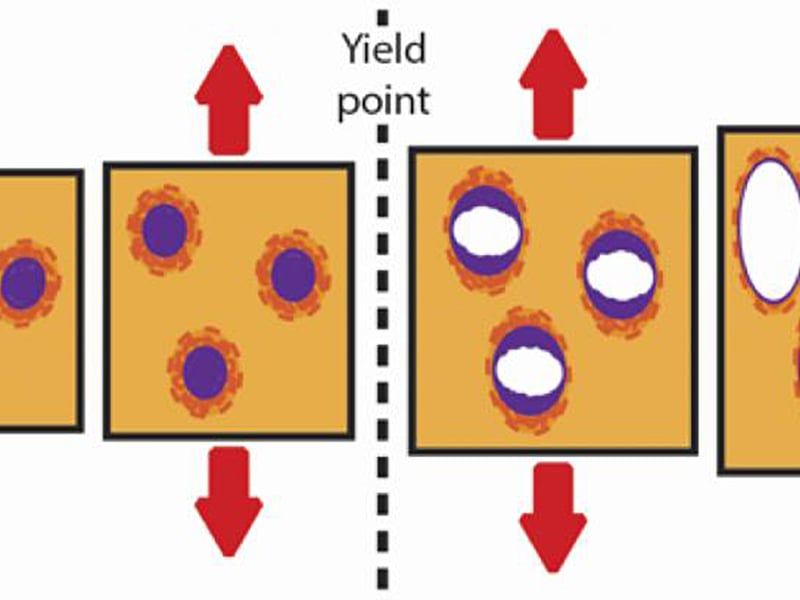
Cavitation in Block Copolymer Modified Epoxy Revealed by In Situ Small-Angle X-Ray Scattering
Frank Bates & Lorraine Francis (IRG-1)
Addition of rubber particles to epoxy thermosets has been successful for toughening these brittle materials.
Jan 22, 2014
University of Minnesota - Twin Cities
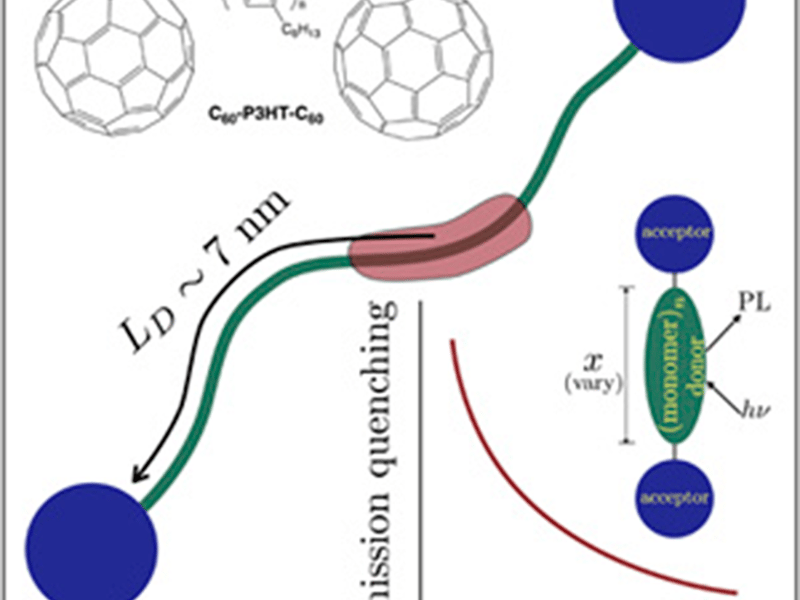
Intramolecular Exciton Transport in Conjugated Polymers
David Blank (IRG-2)
Using a series of acceptor-polymer-acceptor triads, IRG-2 investigators have measured intramolecular exciton diffusion in poly-3(hexylthiophene) (P3HT) for the first time.
Jan 22, 2014
University of Minnesota - Twin Cities
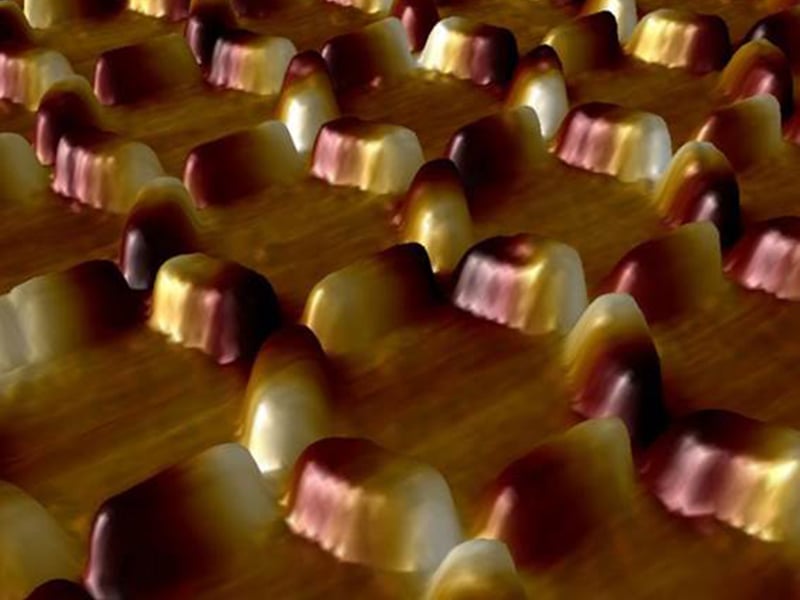
Magnetic Charge Crystallization in Artificial Spin Ice
Chris Leighton (IRG-3), in collaboration with the Univ. of Illinois, Penn State, and Los Alamos
“Artificial spin ice” is a term used for arrays of nanoscale magnetic islands on lattices that geometrically frustrate inter-island interactions.
Showing 791 to 800 of 1441