Highlights
Jan 26, 2011
University of Minnesota - Twin Cities
Printed, Flexible Carbon Nanotube Digital Circuits
Dan Frisbie
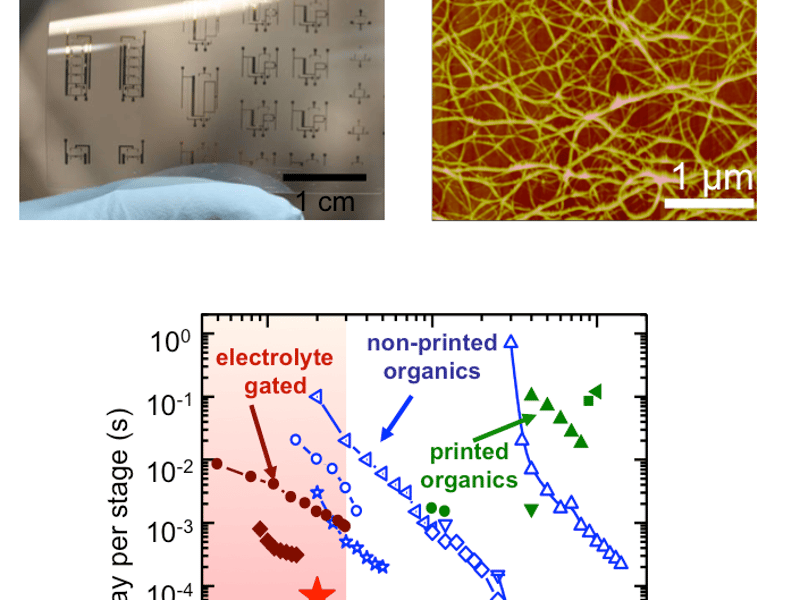
Graduate student Mingjing Ha working with Optomec, Inc. and Northwestern University collaborators (Mark Hersam) has demonstrated low voltage, fast carbon nanotube (CNT) circuits printed on flexible plastic substrates. The circuits are fabricated by aerosol jet printing from a liquid dielectric ink (ion gel) and a purified semiconducting CNT ink (Northwestern). The printed semiconducting CNTs form the channels in thin film transistors and printed circuits.
Jan 12, 2011
University of Minnesota - Twin Cities
ZnO Nanowires for DNA Electrophoresis
Kevin Dorfman, Eray Aydil
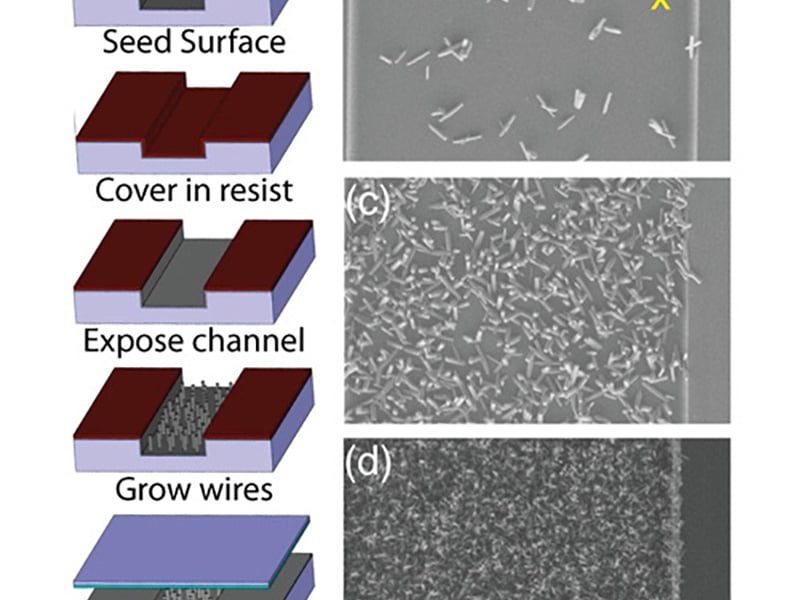
Our team has developed a simple solution-based method to fabricate arrays of ZnO nanowires inside of a glass microchannel.
Jan 12, 2011
University of Minnesota - Twin Cities
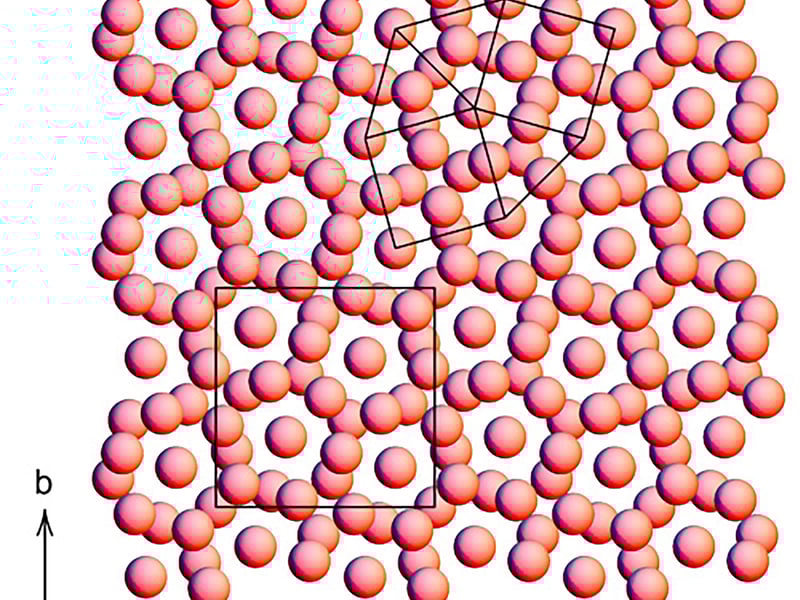
Discovery of a Frank-Kasper σ Phase in Sphere-Forming Block Copolymer Melts
Frank Bates
Ordering of spherical particles represents a fundamental topic in materials science and engineering ranging from the sub-nanometer scale packing of atoms in simple crystals to micron sized assemblies of colloids.
Jan 11, 2011
Cornell University
Graphene Grains make Atomic Patchwork Quilts
P. Y. Huang et al., Nature (Published Online 5 Jan 2011)
Stitching defects make the film weaker, but have no electronic effect
Dec 20, 2010
New York University
Pleats on Crystals on Curved Surfaces
W.T.M. Irvine, V. Vitteli, P. M. Chaikin
Electrically charged polymer colloids attracted to the surface of water droplets of different shapes crystallize on their curved surfaces.
The curvature frustrates perfect crystallization and defects must be added such as the familiar twelve pentagons which decorate the otherwise hexagonal faces of a soccer ball. The pentagons/disclinations strongly relax curvature.
Dec 1, 2010
Massachusetts Institute of Technology
Multimaterial acoustic fibers
S. Egusa, Z. Wang, N. Chocat, Z.M. Ruff, A.M. Stolyarov, D. Shemuly, F. Sorin, P.T. Rakich, J.D. Joannopoulos, and Y. Fink (MIT MRSEC, IRG-III)
Following up on their recent creation of light-sensitive fibers,
Professors Yoel Fink and Joannopoulos and their research teams have
developed fibers that can detect ("hear") and produce sound ("sing").
Sep 13, 2010
Johns Hopkins University
Lateral Organic Devices
B. M. Dhar, G. S. Kini, G. Xia, B. J. Jung, N. Markovic, and H. E. Katz
Background: Most
organic devices, from organic light emitting diodes to organic
spintronic devices vertical devices, where the essential interfaces are
buried and thus not subject to investigation.
Aug 25, 2010
Brandeis University
Theory of Chiral Smectic A Twisted Ribbons
C. N. Kaplan1, H. Tu2, R. A. Pelcovits2 and R. B. Meyer1
1 The
Martin Fisher School of Physics, Brandeis University
2 Department of Physics, Brown University
Showing 1081 to 1090 of 1452