
Stabilized
emulsions containing the oscillating Belousov - Zhabotinsky chemical reaction (BZ) show interesting dynamics. Each drop acts as an independent chemical clock.
However, they chemically communicate and exhibit collective behavior. In (a)
six BZ drops are contained in a
capillary tube. The white bars
are light, which set the oscillators in the reduced state. Drops 1 & 6 are
always exposed to light, setting the boundary conditions. Drops 3 & 4 are
exposed to light for 0.5 periods. (b) A space time plot of the oscillations. White
corresponds to the oxidized state; black to reduced. The drops adopt a dynamic
oscillatory state predicted by theory. (c,d) Photograph and schematic, respectively, of
experimental set-up. Study of these systems will elucidate a variety of
chemically dynamic systems, ranging from neurons to Active Matter – polymeric
systems which can convert chemical energy to mechanical motion.
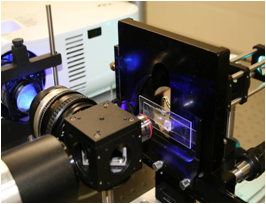
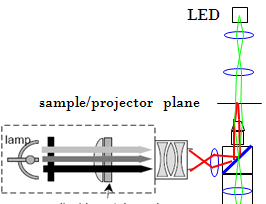
The BZ reaction
serves as the paradigm for non-linear chemical oscillators. Oscillating
chemical cycles are essential components of much of biology, including the
function of neurons and neural networks as well as for cell division and other
cyclic and circadian rhythms. Our goal
is to characterize the dynamical behavior of these BZ emulsions and model their
behavior. Because we can control many aspects of the individual oscillators and
the degree of coupling, we believe this work will serve as a model system for
interacting chemical oscillators.