Highlights

Apr 20, 2009
University of Chicago

Charge transport in arrays of multicomponent nanostructures

Jong-Soo Lee (University of Chicago) Elena V. Shevchenko (Argonne National Laboratory) Dmitri V. Talapin (University of Chicago)

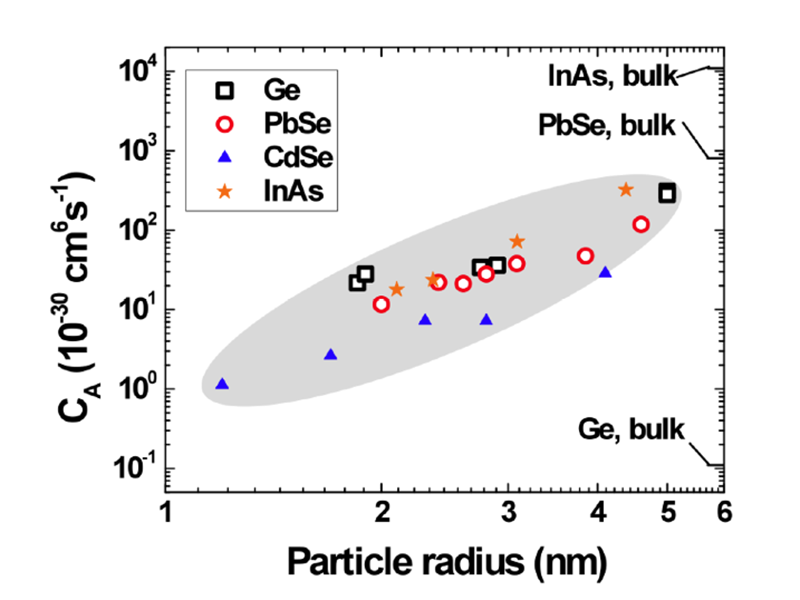
Researchers, Dmitri Talapin and collaborators, at the University of Chicago MRSEC have been studying electronic properties of new nanoscale materials consisting of both magnetic and semiconducting components (FePt and PbS).Â’  These components are integrated into individual nanostructures forming multicomponent quantum-confined objects.Â’  The core-shell morphology maximizes the interaction between the components and provides a convenient platform for studying
Apr 1, 2009
University of Nebraska - Lincoln

Stripes are Stars! Pt Helps Fe to Stay Magnetized

A. Enders, R. Skomski (Nebraska MRSEC), J. Honolka, K. Kern, K. Fauth, G. Schuetz (MPI Stuttgart, Germany), P. Varga (TU Vienna, Austria) and H. Ebert (LMU Munchen, Germany)

The magnetic anisotropy energy is among the most important functional properties of magnetic elements. It determines the orientation and stability of the magnetization as well as the mechanisms and the dynamics of the magnetization reversal.
Apr 1, 2009
Massachusetts Institute of Technology

Battery material could lead to ultra-fast recharging of many devices

Gerbrand Ceder (MIT), ByoungWoo Kang (MIT)

  Professor Gerd Ceder, co-leader of the MIT battery IRG, and MRSEC-supported graduate student ByoungWoo Kang wanted to dispel the myth that batteries have low power rates.
Mar 26, 2009
Stanford University

Green Chemistry of Poly(l-lactides)

W. Swope1, R. Waymouth2, J. Hedrick1, and C. Wade1 1: IBM Almaden Research Center, 2: Stanford University

As part of a series of studies on the green chemistry of poly(l-lactides), we have performed a theoretical study of the mechanism of ring-opening polymerization.
Mar 26, 2009
Stanford University

Polymer Dynamics in Concentrated Solution

Ajay Dambal and Eric Shaqfeh, Dept. of Chemical Engineering, Stanford

The dynamics of entangled polymer solutions far from equilibrium is, at present, a subject of considerable interest because the "natural" modifications to tube or reptation-based theories have not been successful.Â’  In such systems, polymer molecules are highly entangled, which results in the motion o
Mar 26, 2009
Stanford University

Flow-Enhanced Vesicle Deformation in the Four-roll Mill

Susan Muller, Dept. Chemical Engineering, UC Berkeley

This project leverages ongoing research on the dynamics of DNA and vescicles within CPIMA.Â’  We have developed a novel microfluidic four-roll mill that allows all flow types (from extension to shear to rotation) to be accessed and have previously used it to examine DNA tumbling in mixed flows and, most recently, to study vesicle dynamics.
Mar 26, 2009
Stanford University

DNA-tethered Membrane Formation From Giant Unilamellar Vesicles

M. Chung and S. Boxer, Dept. of Chemistry, Stanford University

We have developed two strategies forÂ’  preparing tethered lipid bilayer membrane patches on solid surfaces by DNA hybridization.Â’  In the first strategy, single-stranded DNA strands are immobilized by click chemistry to a silica surface, whose remaining surface is passivated to prevent direct assembly of a solid supported bilayer.Â’  Then giant unilamellar vesicles (G