Highlights

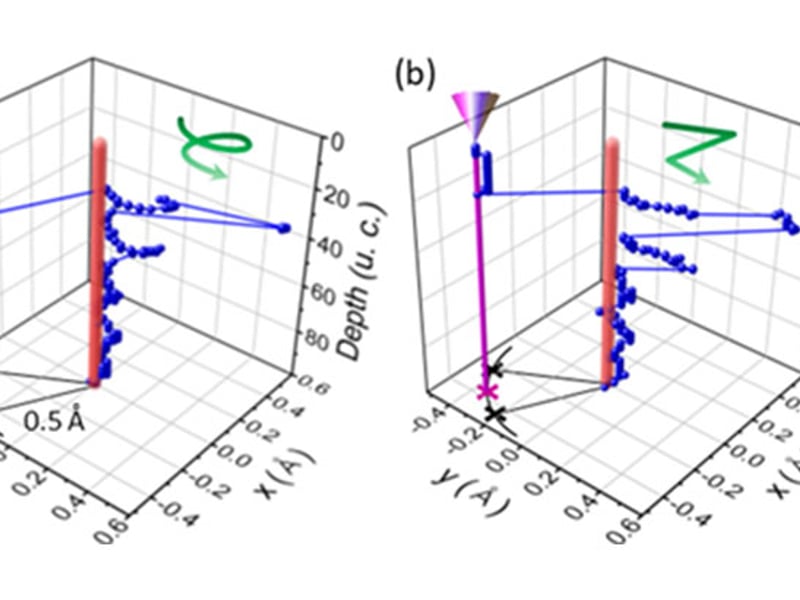
Predictive model of the static structure and the evolution of the system.
Jun 8, 2018
University of Chicago

Tunable nechanics and dynamics in biopolymer-based nematic materials

David Kovar and Gregory Voth groups

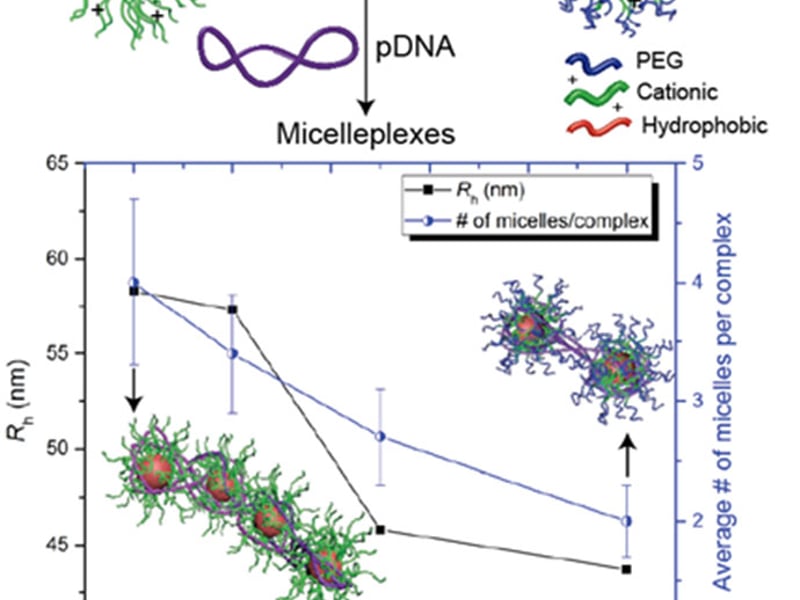
At the University of Chicago MRSEC, we have shown that building blocks of the biopolymers, actin and microtubule, form lyotropic liquid crystals with controllable structure and mechanics.
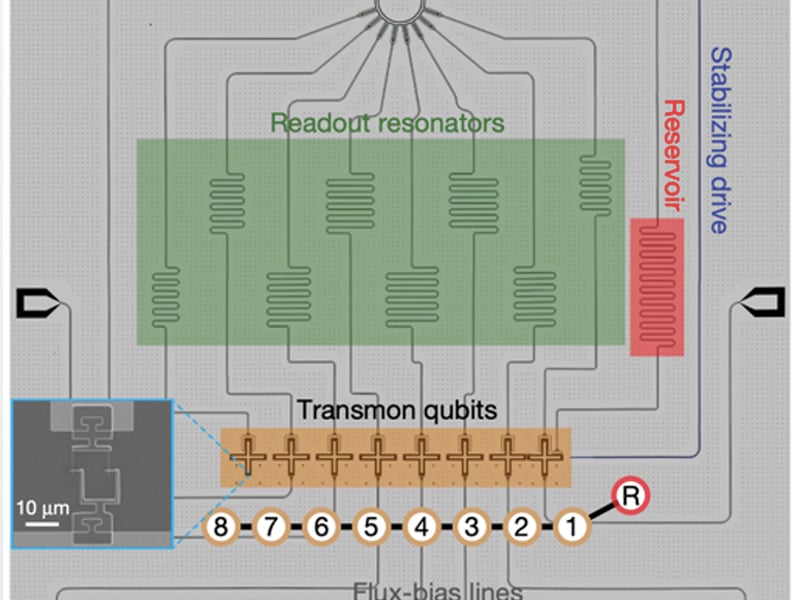
Rabi-swap pulse sequence. The qubit and resonator interact for a time τ , and the qubit state is then measured.
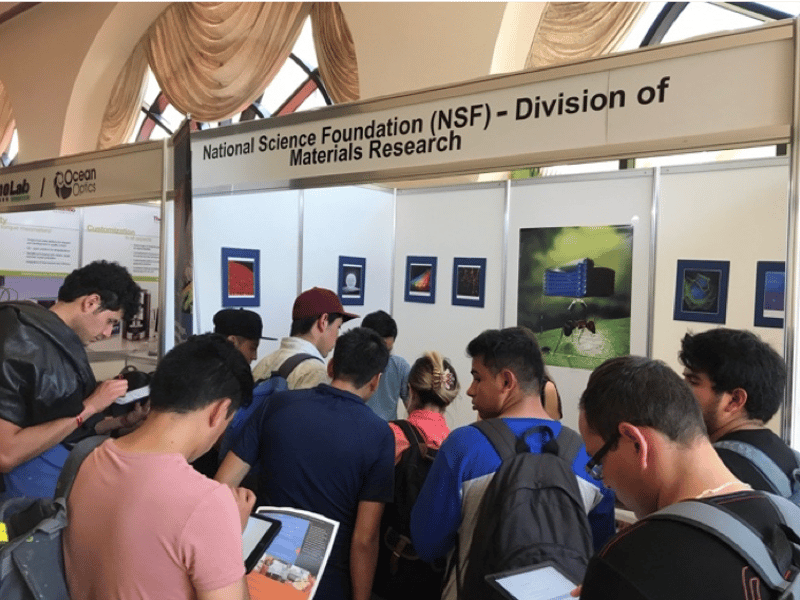
MRSEC representatives and conference attendees interact at the International Materials Research Congress in Cancun, Mexico.
Jun 5, 2018
Northwestern University

NSF-MRSEC Booth at the International Materials Research Congress

Following a successful inaugural year in 2016, a NSF-MRSEC booth was again featured at the XXVI International Materials Research Congress (IMRC) in Cancun, Mexico on August 19-25, 2017 to increase awareness, promote international collaboration, and broaden participation from traditionally underrepresented groups in the National Science Foundation Materials Research Science and Engineering Center (NSF-MRSEC) program. Dr. William Kung (Northwestern University), Ms. Michelle McCombs (Ohio State University), and Ms.
Research Experience for Teachers (RET) participants with the RET Program Director, Professor Lincoln Lauhon (left).
Jun 5, 2018
Northwestern University

Research Experience for Teachers

Since its inception in 1992, the NU-MRSEC has offered the Research Experience for Teachers (RET) program each summer to middle-school, high-school, and community-college teachers with the principal goals of engaging them in research, developing a network of scientific colleagues, learning about new scientific and technological developments, and transferring this knowledge to the classroom. Concurrent with their summer research, teachers develop a related curriculum project to be implemented in their classrooms and shared with colleagues and administrators.
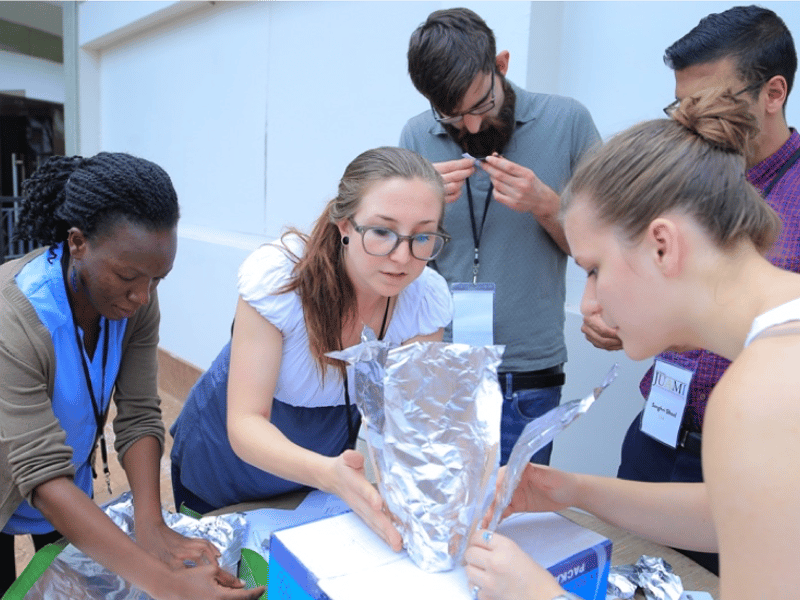
Volunteers and attendees interact during HerStory at the Chicago Museum of Science and Industry.
Jun 5, 2018
Northwestern University

HerStory at the Chicago Museum of Science and Industry

In collaboration with the Chicago Museum of Science and Industry, HerStory is an outreach event that encourages young girls, particularly underrepresented minorities, to pursue science in academia and beyond. The event agenda includes a massive scavenger hunt at the museum that featured exhibits of famous female scientists in each wing of the museum. Volunteers and young women from across the Chicagoland area participated in the event.
Encapsulating 2D materials with boron nitride narrows emission linewidths, which is useful for integration into photonic devices.
Jun 5, 2018
Northwestern University

Encapsulated 2D Heterostructures for Enhanced Layered Optoelectronics

Two-dimensional (2D) layered materials have many features suitable for optoelectronic devices, but poor quality substrates can degrade optical properties. By encapsulating a monolayer semiconductor in layers of atomically-thin hexagonal boron nitride, a nearly pristine environment can be achieved free from surface roughness and defects of typical substrates.
Examples of the wide range of 3D microstructures that can be realized by controlled mechanical buckling of patterned two-dimensional materials.
Jun 5, 2018
Northwestern University

Controlled Mechanical Buckling for Origami-Inspired 3D Microstructures

A new strategy has been introduced to exploit mechanical buckling for autonomic origami assembly of three-dimensional (3D) microstructures across a wide range of material classes, including soft polymers and brittle inorganic semiconductors, and length scales from nanometers to centimeters. The engineered folding creases are created through spatial variation of thickness in the initial two-dimensional structures.
(Left) Scanning electron microscopy images of DNA-linked gold nanodisk stacks. (Right) Optical extinction spectra of the stacks.
Jun 5, 2018
Northwestern University

Tuning Optical Properties with DNA-Linked Gold Nanodisk Stacks

Recent advances in gold nanoparticle synthesis combined with functionalization with DNA linkers has enabled the self-assembly of stacks of gold nanodisks in which the optical spectra can be tuned and modulated by controlling the stack structure (e.g., particle spacing, arrangement, and stack length). The figure shows three possible arrangements of the particles, and the corresponding spectra that are associated with the plasmon resonance excitation in the stack.
Schematic of the molecular structure and vibrational modes of the perylene diimide molecules used in this study.
Jun 5, 2018
Northwestern University

Probing Intermolecular Interactions with Intramolecular Resolution

At the nanometer-scale, the surface area to volume ratio increases substantially compared to bulk materials. Consequently, methods for functionalizing and passivating surfaces can play a dominant role in determining the properties of nanomaterials. Of particular interest are self-assembled monolayers of organic molecules that have been widely used to control the electronic, optical, chemical, and frictional properties of nanomaterials in a range of applications.
(a) Thin-film transistor structures. (b) Mobility as a function of PEI concentration. (c) Schematic energy band diagram illustrating the shift of the In2O3 work function with PEI.
Jun 5, 2018
Northwestern University

High Performance Heterojunction Oxide Thin Film Transistors

Due to their outstanding electronic properties and high optical transparency, metal oxide thin-film transistors have significant potential in state-of-the-art flat panel display technologies. Here, high performance solution-processed metal oxide thin-film transistors were realized by fabricating heterojunctions of indium oxide (In2O3) and polyethylenimine (PEI) as the semiconducting channel layer. Due to the tunable work function of the In2O3-PEI blends, electron mobilities as high as ~10 cm2V-1s-1 were obtained.