Property Measurement Facility
Location: Singh 107/108
Coordinator/expert user:
Prof. Jay Kikkawa (Physics) 215/898-7522
e-mail: [email protected]
 Instruments:
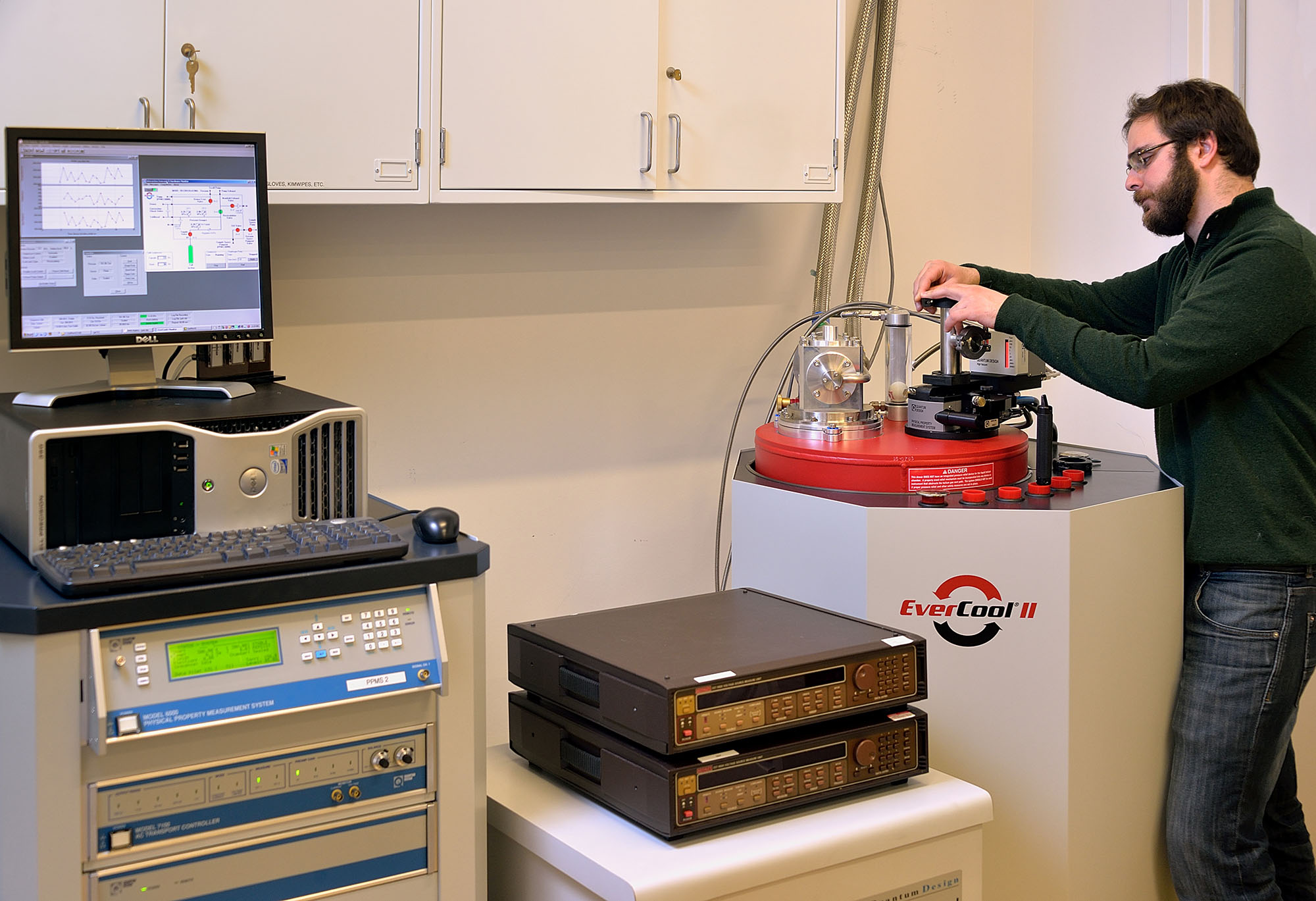
- Quantum Design PPMS 9 Tesla with Evercool II
- Quantum Design PPMS 9 Tesla
- Quantum Design MPMS 7 Tesla with Evercool
- Princeton Instruments TriVista Spectrometer with Si and InGaAs array detectors
This user facility allows users to perform a wide range of measurements. Equipment includes 2 Quantum Design PPMS systems capable of 9 T magnetic fields and temperatures from 1.7 K to 400 K, a Quantum Design MPMS SQUID magnetometer capable of measurements from 2° K to 800° K, a custom-built optical absorbance/photoluminescence system with detection bandwidth from 350 nm to 1.7 microns, and a glove box with micromanipulator probes. Between these systems, users are able to perform DC magnetic moment, AC magnetic susceptibility, 2- and 4-wire magnetoresistance, thermal conductivity, heat capacity, photoconductivity, photoluminescence, absorbance, Hall effect, and optically induced magnetic moment studies. We have a triple grating Raman spectrometer. We now have continuous helium reliquification for one PPMS system as well as our MPMS SQUID. Domestic and international users from institutions with historically underrepresented minority (URM) student populations are encouraged to discuss their measurement needs with us.
Imaging and Characterization Facility
The Center for Research on Interface Structure and Phenomena (CRISP) facilities include core shared instrumentation of the YINQE laboratory in the Malone Engineering Center, This core facility includes SEM, TEM, FIB, AFM, and electron-beam lithography. Check out The YINQE web page for a complete description. CRISP has several more specialized instruments in Becton Center.
CRISP facilities in the Becton Engineering Center include tools for x-ray diffraction, x-ray photoelectron spectroscopy, and SQUID magnetometry.
The more specialized instruments are used to grow thin films using oxide molecular beam epitaxy (MBE). These tools can grow materials with a precision of an atomic layer. Yale has the highest concentration of oxide MBE tools in the world and makes contributions toward next-generation electronic devices.
Nanostructures Laboratory
The Nanostructures Laboratory is a part of the Materials Research Science and Engineering Center (MRSEC) and the Silvio O. Conte National Center for Polymer Research at the University of Massachusetts at Amherst. It is equipped with several Atomic Force Microscopes, Optical Microscopes, Variable Angle Spectroscopic Ellipsometer (VASE), Thin Film Optical Profilometer, Stylus Profilometer, Metal Evaporator etc. for the use of UMass community and as well as from other academic institutions and Industry. The mission of the Keck Nanostructures Laboratory is to provide access to material characterization equipment, technical support, training and consultation, as well as to perform a range of services for users in the area of Atomic Force Microscopy (AFM), Variable Angle Spectrocopic Elliposmetry (VASE) and Optical Microscopy. The laboratory capabilities include high-resolution imaging of materials structure, Thin Film characterization etc. In addition the Nanostructures Laboratory has access to the Confocal Laser Scanning Microscope from the Optical Microscope facility of the MRSEC.
Center for Atom Probe Tomography (NUCAPT)
Atom-probe tomography (APT) is a microanalytical instrument producing an atom-by-atom three-dimensional reconstruction of a sample, with sub-nanometer resolution with a typical analyzed volume of about 150 x 150 x 500 nm3 . APT is particularly suitable to investigate nano-structured materials. Typical micro- and nanostructural features studied are: composition and morphology of second-phase precipitates or small clusters of solute atoms, compositional variation in modulated structures, multi-layer thin-film structures, dopant profiles of semiconductor structures (transistors), and analysis of the chemistry and topology of internal interfaces. Specimen preparation of almost any material is now possible employing a dual-beam focused-ion beam (FIB) microscope, which allows targeted sample preparation of a specific feature, such as a grain boundary or an individual transistor in a semiconductor device.
Mass Spectrometry Facility (UMASS-MSC)
The Center (UMASS-MSC) provides state-of-the-art analytical equipment, analytical services and expertise in mass spectrometry for UMass-Amherst, neighboring scientific communities and their collaborators. Currently, UMASS-MSC serves the needs of more than 30 groups with active life science research interests by facilitating a) development of new organic/inorganic synthetic materials; b) analysis of variety of post-translational modifications in proteins, including biopharmaceuticals; c) quantitative comparative analysis of protein levels; d) fundamental studies in protein/protein and protein/ligand interaction research areas etc., owing to its expanding capabilities in modern methods of mass spectrometry.
UMASS-MSC is also actively used within the framework of the NIH-funded Chemistry-Biology Interface (CBI) program (5T32 GM008515-15). Nineteen training faculty of the CBI program are users of the Facility’s instrumentation.
UMASS-MSC houses hybrid Quadrupole Time-of-Flight (Applied Biosystems QStar-XL), Double-Focusing Magnetic Sector (JEOL-700 MStation), Fourier-Transform Ion-Cyclotron Resonance (Bruker's SolariX 7T FT-ICR), Matrix-Assisted Laser Desorption Ionization (Bruker's MALDI-OmnifleX), Bruker Esquire-LC Ion Trap mass-spectrometers and several HPLC, including Ultimate Nano-LC Packings, and GC Systems.
Polymer Characterization Facility
The Polymer Characterization Facility is maintained by the CEMS Polymer Group, but is available to researchers campus wide, and also to industrial clients (IPRIME Industrial Partners get a significant discount). Assistance or collaboration is available for testing, training, and interpretation of results. The Rheology Lab is a major part of the Polymer Characterization Facility, and rheometry can be a sensitive probe of structure in complex materials such as polymers.
Scanning Electron Microscopy/Scanning Tunneling Microscopy/Atomic Force Microscopy Facility (UHV-SEM/STM/AFM)
This ultrahigh vacuum facility consists of a scanning electron microscope, atomic force microscope, and scanning tunneling microscope combined in one state-of-the-art instrument (JEOL JSPM-4500A). This instrument allows for multi-scale microscopy at variable temperatures and proximal probe measurements of devices, growth structures and attendant fields. Control electronics are suitable for MFM/EFM measurements and provide scanning Kelvin probe force microscopy (SKPM) at sub-nanometer spatial resolution. Sample fabrication capabilities - ion gun, single and multimode effusion cells with collimation and spot positioning for in-situ deposition on the SPM stage - extend the scope of experiments. This facility is operated cooperatively with the Department of Physics.
UD Keck Center for Advanced Microscopy and Microanalysis
The W. M. Keck Center for Advanced Microscopy and Microanalysis (Keck CAMM) houses two 200 kV field emission transmission electron microscopes (Talos F200C and JEM-2010F), one 300 kV transmission electron microscope (JEM-3010), one 120 kV transmission electron microscope (Tecnai-12), two field emission scanning electron microscopes with FIB-SEM dual beam capability (Auriga 60 and JSM-7400F), and two scanning probe microscopes (Dimension 3100V and Multimode NanoScope V).
See Facility Type below. Additional Facility Types:
In-Situ TEM
Cryo-TEM
Cryo-SEM
Facility Primary Contact: Chaoying Ni
The Nanoscale Fabrication Center (NFC)
The Nanoscale Fabrication Center (NFC) at the University of Wisconsin-Madison provides a research facility for microfabrication technologies, products and innovations. In order to give students a state-of-the-art education and to maintain leading-edge research programs, we continue to improve this advanced laboratory.
NFC maintains a suite of semiconductor and microfabrication processing equipment in a cleanroom laboratory. Access to the lab and to all equipment is available to qualified users from the University of Wisconsin, other education institutions, or industry. WCAM is a cost recovery facility.
The laboratory is located on the third floor of the Engineering Centers Building on the University of Wisconsin-Madison campus. Click here for a searchable UW campus map, or return to the NFC home page for more contact information.
For use, questions or more information, please contact the DIrector of MRSEC facilities:
Dr. Jerry Hunter ([email protected])
(608) 263-1073
Showing 371 to 380 of 2651