JHU Materials Research Science Engineering Center (2005)
This Materials Research Science and Engineering Center (MRSEC) at Johns Hopkins University is focused on one of the most important new research areas: science and technology of magnetoelectronics. Conventional microelectronic devices, such as microchips, use electric currents - the motion of electric charge as carried by electrons in metals and semiconductors - to control and manipulate information. However, in addition to charge, electrons possess an attribute known as "spin," which makes them tiny magnets, and it is the collective alignment of these spins in materials such as iron that leads to the phenomenon of magnetism. Spin alignment in magnetic materials is the basis of information storage on hard disks and magnetic tapes. In magnetoelectronics, dynamic control of electron spin allows one to transmit and manipulate information in new ways, and the first generation of "spintronic" devices--read heads for computer hard drives, have made possible the huge increase in information storage capacity in recent years and resulted in the explosive growth in computer-based technologies. Advances in this field require nanoscale control of materials properties and device architectures. This MRSEC brings together scientists and engineers with wide-ranging and complementary expertise to carry out research in several extremely promising areas of nanostructured materials for magnetoelectronics: (i) magnetic tunnel junctions that have potential for use in dynamic memory devices, (ii) the science of novel ring architectures for magnetoelectronic devices, (iii) organic semiconductor devices that have potential to expand magnetoelectronics into the rapidly developing field of low-cost, printable electronics, and (iv) nanostructures that will enable new approaches for the transport of spin information.
The MRSEC's research activities will have far-reaching impact on a new generation of magnetoelectronics devices. The Center will foster interactions with relevant industries to leverage the expected scientific advances to realize fully their technological potential. As an integral part of its research program, the Center will provide interdisciplinary research training and education for post-docs, graduate students, and undergraduates, preparing them for careers at the cutting edge of science and engineering in industry, academia, and national laboratories. The Center's education outreach programs will encourage young people to pursue scientific careers, provide continuing education and new curricular material for teachers, and introduce the public to the excitement and importance of materials research. In all of these programs, the MRSEC will promote the participation of women and members of underrepresented groups.
Cornell Center for Materials Research (2005)
The major theme of the MRSEC research and education programs at the Cornell Center for Materials Research (CCMR) is Mastery of Materials at the Atomic and Molecular Level. The objective is to educate scientists and engineering students (largely PhD students) and postdoctoral researchers in the methods of research used to tackle cutting edge problems in materials research. At the same time CCMR manages and maintains a set of shared experimental facilities that enable this research to be carried out; these facilities are also actively used by a wide spectrum of researchers from across the campus, from other Universities, Government Laboratories and Industry. CCMR also has an expansive and effective educational outreach program that helps students and teachers from primary, secondary and local colleges to learn about materials sciences, recent advances and how to integrate this new knowledge into the classroom. Finally, CCMR's Industrial Partnerships program speeds the transition of new scientific discoveries into technologies that can promote economic growth and opportunities.
Our research is organized into teams focused on several specific topics, including: Controlling Electrons at Interfaces, "Building Blocks" for Photonic Systems, and the Study of the Dynamics of Growth of Complex Materials. CCMR also manages a "Seed Program" that supports smaller short term activities that explore high-risk/high-payoff areas and that integrates new faculty into our interdisciplinary culture. Our long term goal is to control materials systems at or near the level of atomistic precision (atom identity and geometric placement), as is possible in the synthesis of some organic molecules. Our vision is that such control will allow precision tuning of properties and is likely to uncover vast new areas of science, to facilitate the construction of a wide variety of novel devices, and to enable technologies not presently imagined. The proposed research capitalizes on unique science we recently developed, substantially extends the effort in new and ground breaking directions, and explores entirely new topics; all require new talents, new skills and new senior investigators.
Superseed: Electrical-Optical Quantum Transduction
This seed project focuses on developing materials capable of coherently transferring quantum information between electrical circuits and optical photons. The research investigates materials systems that can support both microwave and optical excitations, with a particular focus on color centers—atom-like structures in wide-bandgap semiconductors that serve as interfaces between these domains. These centers exhibit spin excitations tunable to microwave frequencies and spin-dependent optical transitions, often in the telecom band.
Despite their coherence, color centers pose challenges in coupling due to their localized spin states and small sizes. Rare earth ions such as erbium require specific host materials to preserve their properties, but these materials may not be optimal for integration into metamaterials or other quantum systems.
The project explores two materials science pathways to enable coherent electrical-optical coupling. The first involves the development of novel color centers with improved coherence and optical stability compared to existing systems such as nitrogen vacancy centers in diamond. The second focuses on optimizing host materials and electrical qubit coupling to address scale mismatches between color centers and microwave photons. By leveraging theoretical operating protocols and new materials platforms, the research aims to significantly enhance magnetic, electrical, and acoustic coupling for quantum information applications.
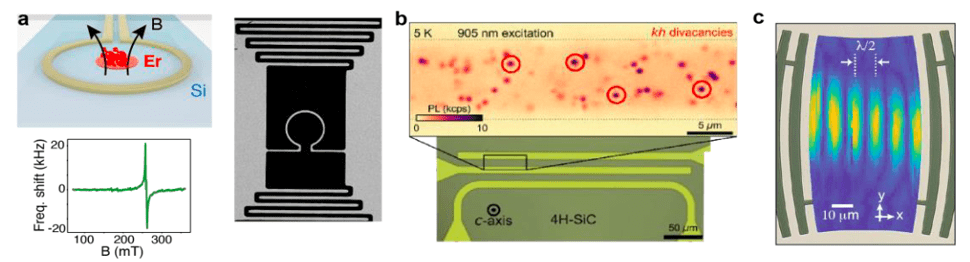
Three physical modalities of coherent coupling between spins and microwaves. (a) Magnetic coupling to spins using a low impedance superconducting circuit (schematic and device images shown) and preliminary ESR signal. (b) Photoluminescence of electrically biased divacancy spins in 4H-SiC, in between two electrodes. (c) X-ray strain measurements of surface acoustic waves in a Gaussian used to acoustically control spins.
IRG 2: Activated Architectured Materials
This IRG focuses on designing and building shape-morphing hybrid materials with programmable and self-regulating transport properties by integrating concepts from active matter and inorganic materials science. The goal is to develop activated architectured materials that autonomously respond to their environment, similar to biological systems, enabling applications such as artificial skin and self-printing ink-jet drops.
The research explores two key activation routes:
Route 1 – Activation modifies transport properties, such as fluid viscosity, leading to structural changes (e.g., self-shaping droplets).
Route 2 – Activation directly alters a material’s structure, which in turn affects properties like thermal transport.
The IRG is organized into three focus areas (FAs):
FA1: Develops activated fluids (metafluids) composed of self-spinning colloids and nanoparticles to enable spatiotemporal control of stresses for self-printing ink-jet drops.
FA2: Investigates activated sheets that integrate biological and inorganic materials, using biomolecular motors to manipulate shape, optical, and thermal properties.
FA3: Combines elements of FA1 and FA2 to develop composite structures, such as artificial skin, by integrating epithelial cells with soft polymer electronics for biomechanical functionality.
By harnessing the interplay between activation, material architecture, and transport properties, this research aims to establish a new paradigm in materials science, bridging the gap between synthetic and biological systems.
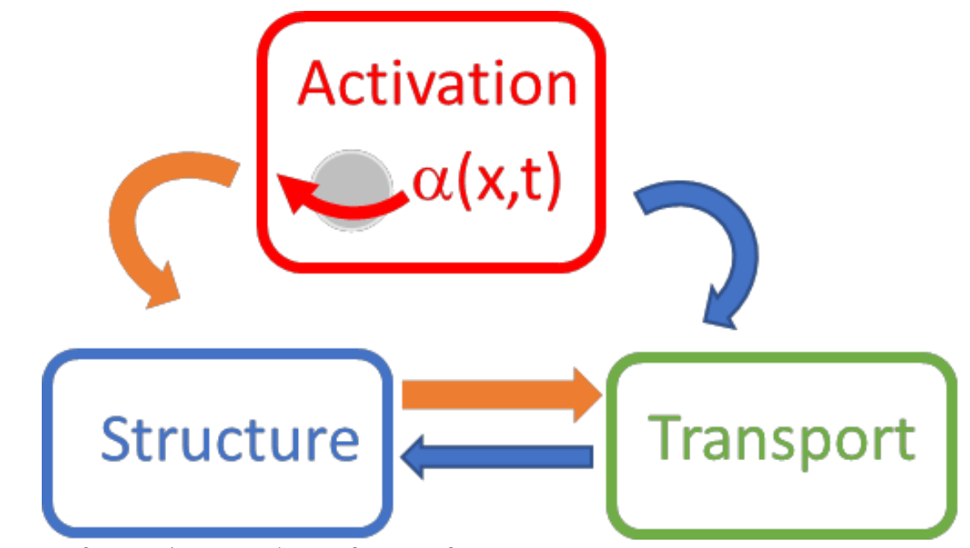
Material components (gray circles) are activated with spatial and/or time control (α(x,t)) to drive local motion and force (red arrow). This local activation controls material response through two routes, as described in the text.
IRG-1: Ionic Control of Materials
The goal of IRG-1 is to understand the mechanisms, capabilities, and applications of electrostatic and electrochemical gating and to gain electrical control over a wide range of electronic phases and functions.

IRG 1: Trainable Soft Materials
This IRG explores the concept of materials training, drawing inspiration from biological adaptation to develop materials that can evolve their properties in response to external stimuli. Unlike traditional materials design, where parameters remain fixed, this research aims to create trainable materials that modify their internal structure and functions through applied mechanical stress—similar to how bones strengthen under repeated use.
The focus is on soft materials, which have highly adaptable configurations, making them ideal candidates for imprinting memory and evolving properties through structured training protocols. The research investigates how different training methodologies can lead to emergent behaviors such as impact absorption, shape morphing, and multi-functional actuation. A key goal is to develop a systematic framework for designing trainable soft materials, leveraging interdisciplinary insights from materials science, polymer chemistry, soft matter physics, and biological systems.
The group is structured into three focus areas (FAs), each targeting a specific type of soft matter network:
FA1: Macroscopic network-based materials (adapting structural links)
FA2: Dynamic polymer networks (allowing node reconfiguration)
FA3: Particle/gel-network composites (integrating both link adaptation and node reconfiguration)
By understanding trainability, learning, and memory in these systems, this research aims to establish new paradigmsfor materials processing, enabling materials that can be retrained and repurposed for different functionalities without requiring a full redesign.
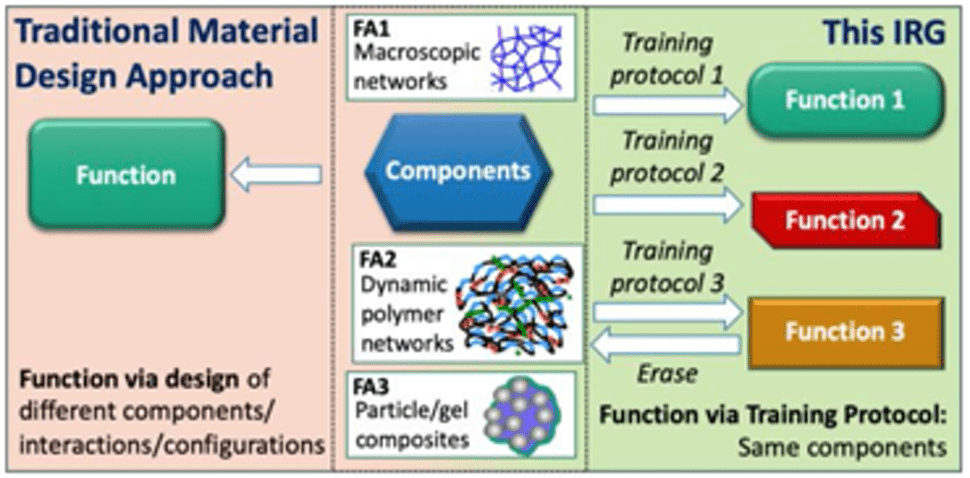
Traditional materials design vs. a materials training approach and the three focus areas (FAs) of Interdisciplinary Research Group 1.
MIT Center for Materials Science and Engineering (2008)
The underlying mission of the Materials Research Science and Engineering Center (MRSEC) at the Massachusetts Institute of Technology will enable - through interdisciplinary fundamental research, innovative educational outreach programs, and directed knowledge transfer - the development and understanding of new materials, structures, and theories that can impact the current and future needs of society. The Center supports a broad-based interdisciplinary research program. The research is conducted in three interdisciplinary research groups (IRGs). These include Design of Nanomaterials for Electrochemical Energy Storage and Conversion (IRG I), which seeks to accurately model, predict, and determine how thermodynamics, phase behavior, and kinetics are modified at the nanoscale, and will use the resultant knowledge to design materials with energy and power-delivery capabilities far superior to those currently available. IRG II on Mechanomutable Heteronanomaterials aims to develop multicomponent polymeric systems with mechanical properties that can be changed on-demand for possible use in sensors and biological applications. Multimaterial Multifunctional Nano-Structured Fibers (IRG III) explores the design, fabrication, characterization, and physical phenomena of a new class of multicomponent nanoscale fiber materials containing conductors, semiconductors (glassy and crystalline) and insulators. In addition there are two Initiative Projects: Engineering Living Cells via Nanomaterials (Initiative I) and New States of Frustrated and Correlated Materials (Initiative II). The first initiative seeks to develop a fundamental understanding of how functionalized polymer multilayers can be integrated with living cells in a manner that preserves cell viability, and allows for new synthetically engineered functionality, whereas the second seeks to synthesize, characterize and examine the fundamental spin physics of new, single crystal materials based on a two-dimensional triangular and kagomé lattice. The Center has a strong, wide-ranging education program directed toward graduate students, undergraduates, middle and high school students and K-12 teachers. Emphasis is placed on including underrepresented minorities in these programs. The education activities enjoy the broad participation of MIT students and faculty and are closely linked to complementary programs in other MIT administrative units. The Center operates shared facilities, including 1) a Materials Analysis Facility, 2) a Crystal Growth and Preparation Facility, 3) an Electron Microscopy Facility, and 4) an X-ray Diffraction Facility. The Center has an effective industrial outreach program, facilitated by a relationship with MIT's Industrial Liaison Program and Materials Processing Center.
IRG 2: Hybrid Quantum Materials with Emergent Terahertz Functionalities (HQ-METs)
Motivation and Impact
Terahertz (THz) electromagnetic radiation could be a powerful tool for applications like biomedical and security screening. However, THz technologies significantly lag those in other wavelength ranges (i.e. Radio Frequency, visible, or near-infrared photonics). This is fundamentally a materials challenge: there is no single material platform that is simultaneously a good source, waveguide, and detector for THz excitations.
KEY CHALLENGE:
Material platforms tend to be well-suited for one THz functionality (e.g. sources, waveguides, or detectors) and poorly suited for others.
VISION:
Understanding and controlling the integration of different material classes allows transduction of THz frequency excitations across the interfaces (Aim 1), control of emergent THz functionality (Aim 2), and creation of hybridized states with fundamentally new properties (Aim 3).
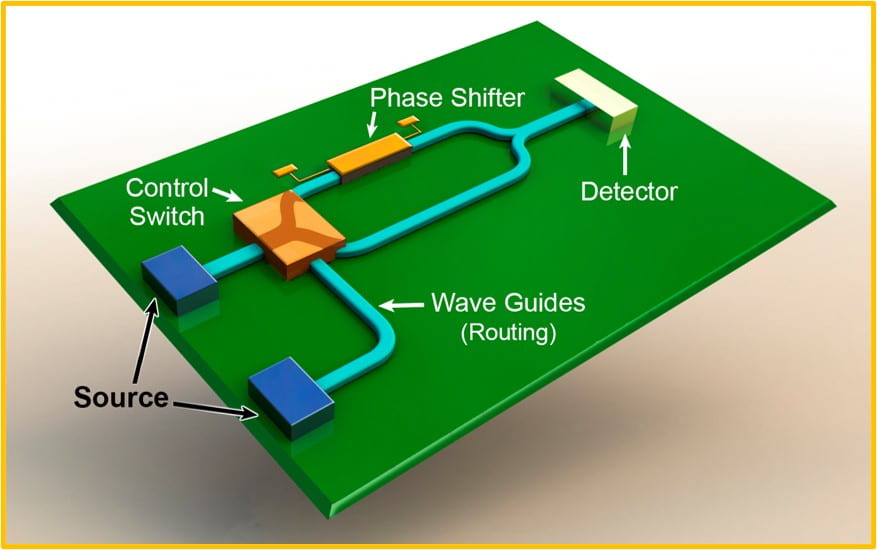
THz frequency photonic integrated circuits would enable new technologies but are hampered by limitations in crucial components and integration challenges.
Harvard Materials Research Center (1994)
The Materials Research Science and Engineering Center (MRSEC) at Harvard University supports interactive research in four major groups covering a broad area of condensed matter and materials science. Researchers in the group focused on new materials are concerned with synthesis, characterization, and theoretical studies of superconductors and superhard carbon-based materials. Investigators in the group concerned with interfaces focus on collaborative aspects of interface science including organic monolayers and thin films, wetting and nucleation, mechanisms of interface motion in amorphous materials, and characterization of semiconductor surfaces. The group investigating electronic and photonic nanostructures addresses size effects and new electronic and photonic phenomena in a variety of materials. The group of researchers involved with design and manufacturing issues aims to develop a new paradigm for choosing the optimum materials and processes necessary to manufacture a component. The MRSEC also supports the development, operation and maintenance of shared experimental facilities for materials research. It provides seed funding for exploratory research, has a minority fellowship program, and fosters research participation by undergraduates. The MRSEC administers an industrial outreach program which is likely to be enhanced by the activities in design and manufacturing. The MRSEC currently supports 23 senior investigators, 12 postdoctoral research associates, 9 technical staff members, 16 graduate students, and 8 undergraduates. The Harvard MRSEC is directed by Professor Frans Spaepen.
Next Generation Materials for Plasmonics and Organic Spintronics (2011)
Vision:
- Become an international leader in plasmonics and organic spintronics research and education.
- Train the next generation of scientists and engineers.
- Create curiosity and excitement in science and engineering among the nation's youth.
- Attract the brightest students and researchers from all diverse segments of society.
Goals:
Plasmonics: Develop new plasmonic materials to enable unique capabilities across the electromagnetic spectrum.
Organic Spintronics: Develop new knowledge, materials, and devices realted to the spin degree of freedom in organic semiconductors.
Seed Program: Develop new areas of collaborative materials research at the University of Utah.
Education and Outreach: Establish a pipeline for the next generation of materials science researchers.
Diversity: Increase diversity among the materials science research community through outreach, student recruitment, faculty hiring, and mentoring programs.
Showing 921 to 930 of 2653