Highlights
Jan 11, 2010
University of Minnesota - Twin Cities
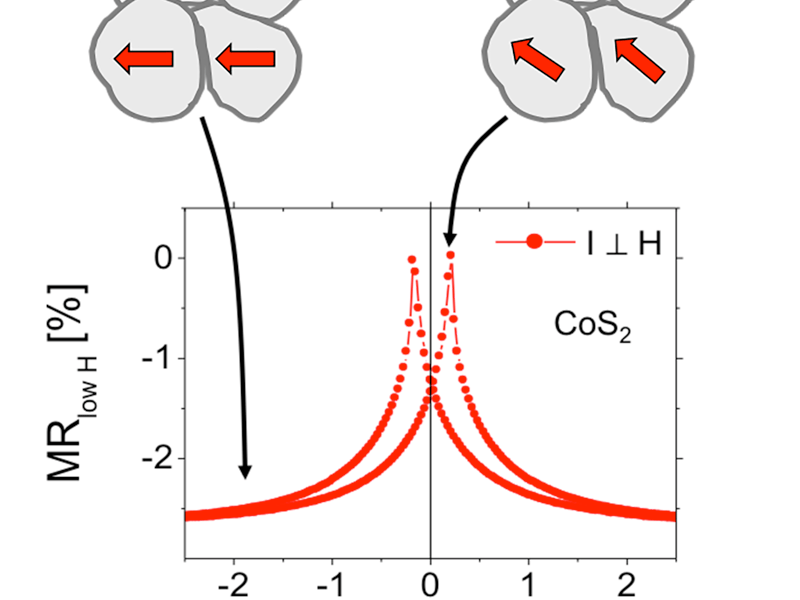
Probing the Spin Polarization of Sulfide-based Spintronic Materials
Mike Manno, Rachel Frakie, Chris Leighton- University of Minnesota
Highly spin-polarized magnets have the potential to radically improve the performance of many spintronic devices.
Jan 11, 2010
University of Minnesota - Twin Cities
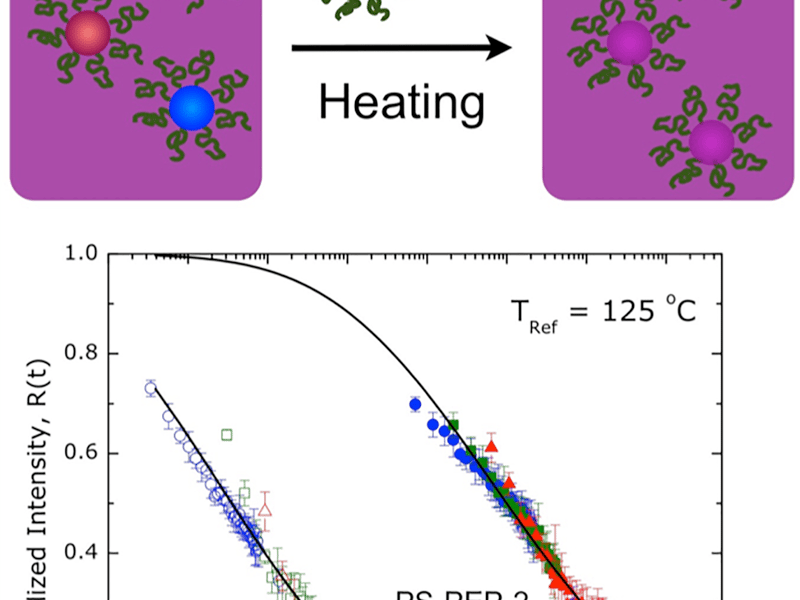
Mechanism of Molecular Exchange in Block Polymer Micelles
Frank Bates, Tim Lodge
Using small-angle neutron scattering, we investigated the mechanism of molecular exchange in spherical micelles formed by diblock copolymers in an organic solvent.
Dec 8, 2009
Massachusetts Institute of Technology
One-way photonic behavior
Zheng Wang, Yidong Chong, J.D. Joannopoulos & Marin Soljacic (MIT)
Research funded in part by the MIT MRSEC has
led to a discovery of one-way photonic behavior. A team made up of MIT
physicists Zheng Wang, research scientist in MIT's Research Laboratory
of Electronics; recent MIT PhD recipient Yidong Chong; Professor John
Joannopoulos; and Professor Marin Soljacic have developed and
experimentally tested photonic crystals that restrict light to travel
Jul 21, 2009
University of Southern Mississippi
Self-Repairable Polyurethane Networks
Polyurethanes have many properties that qualify them as high performance polymeric materials, but they still suffer from mechanical damage. We report the development of polyurethane networks that exhibit self-repairing characteristics upon exposure to ultraviolet light. The network consists of an oxetane-substituted chitosan precursor incorporated into a two-component polyurethane. Upon mechanical damage of the network, four-member oxetane rings open to create two reactive ends.
Jul 21, 2009
University of Washington
Educational, Outreach, & Partnerships at GEMSEC
A rainbow of activities..
All to enhance students’, teachers’ and public’s recognition & appreciation..
of the state-of-the-art Science and Technology at the materials/bio interface;
.. for Students to seek career in Science and Engineering
.. for Teachers for better tools for Teaching
Jul 21, 2009
University of Washington
Synthesis, Assembly and Fabrication of Molecular Materials for Technology and Medicine Using Genetically Engineered Solid-Binding Peptides
The “life” in organisms is due to the specific molecular interactions of proteins, called molecular recognition, that leads to a self-assembly and a large diversity of functions in biology;
Emulating biology, in Molecular Biomimetics, GEMSEC is developing novel protocols towards materials and systems based on proteins, engineered in our labs;
Jul 16, 2009
Massachusetts Institute of Technology
Flexible fiber cameras
Yoel Fink (MIT), Fabien Sorin (MIT), Ofer Shapira (MIT), Matthew Spencer (MIT), Nicholas Orf (MIT) John Joannopoulos (MIT), Ayman F. Abouraddy (U. Central Florida)
A team of researchers, led by Yoel Fink of the MIT MRSEC, has developed
light-detecting fibers that can be woven together to create a flexible,
basic camera. These fibers are each less than a millimeter in diameter,
and consist of several nested layers of light-detection materials. The
fibers measure the intensity of the light illuminating them and convert
it to an electrical signal, which is then fed into a computer that
Jun 29, 2009
University of Oklahoma
Portable Electron Microscope for K-12 Science Lessons
Greg Salamo, University of Arkansas
Graduate students at the University of Arkansas bring cutting edge technology to local middle school students and allow them to explore the world of nanoscience in real-time. The MRSEC graduate students with the help of an education outreach program from the FEI, electron microscopy company were able to bring a portable scanning electron microscope (SEM) into the classrooms of local middle schools.
Jun 22, 2009
Princeton University
Electronic phase transition in graphene in a magnetic field
J. G. Checkelsky, Lu Li, and N. P. Ong
Graphene is comprised of a single layer of C atoms in a hexagonal lattice array. The electronic state of graphene is of great interest because the electron energy increases linearly with momentum, just like for photons and neutrinos. This is called a massless, Dirac dispersion. The nature of the electronic state at zero energy (the “Dirac point”) in a strong magnetic field H is currently the subject of theoretical debate.
Showing 1181 to 1190 of 1452