University of Wisconsin-Madison MRSEC on Nanostructured Materials and Interfaces (2000)
The Materials Research Science and Engineering Center (MRSEC) at the University of Wisconsin supports an interdisciplinary research program on nanostructured materials and interfaces. The research is carried out in three interdisciplinary research groups, with appropriate seed projects. Within IRG 1 the Center focuses on the mechanisms associated with materials integration onto silicon. The ultimate aim is to create "smart" systems based on Si technology for electronic and optical applications. The Center's activities are aimed at understanding and managing heterointerfaces, understanding bonding between dissimilar materials, understanding the role of strain, and effectively utilizing self-organization growth techniques. All of the above are focused on the nanometer scale. Within IRG 2 the goal is to understand actual grain boundaries in high temperature superconductors, which requires an interdisciplinary approach to film growth, materials characterization and modeling. The potential impact is the increase of the maximum current densities that can be carried in such materials for advanced superconducting devices. The activities in IRG 3 are centered on understanding the role of nanostructured textured surfaces on the growth and behavior of biological systems (proteins, viruses, and cells) which have been deposited onto these substrates. A strong feature of the Center's strong educational outreach is the development, testing, and dissemination of instructional materials which can be integrated into high school or college science courses. Of particular interest is the Development of Instructional Materials Program (DIMP) that enables MRSEC graduate students to develop new instructional materials based on their research. The Center carries out an aggressive program to increase the participation of underrepresented groups through enhanced contacts with minority serving institutions. The Center supports well maintained shared experimental facilities, which are accessible to outside users and has a very extensive program of collaborations with industry.
Participants in the Center include 29 senior investigators, 9 postdoctoral associates, 20 graduate students, 15 undergraduates, and 4 technicians and other support personnel. Professor Thomas F. Kuech directs the MRSEC.
Harvard Materials Research Center (2002)
The Materials Research Science and Engineering Center (MRSEC) at Harvard University supports an interdisciplinary research program that includes faculty participants from the Division of Engineering and Applied Sciences, the Departments of Chemistry and Chemical Biology, Physics, Earth and Planetary Sciences, and the Medical School. The MRSEC research is organized into four interdisciplinary research groups (IRGs). IRG1, Multiscale Mechanics of Films and Interfaces, investigates the mechanical properties of thin films at scales intermediate between atomistic and continuum. IRG2, Engineering Materials and Techniques for Biological Studies at Cellular Scales, focuses on understanding the mechanical properties of the cell and its structural components. IRG3, Interface-Mediated Assembly of Soft Materials, explores innovative ways to make self-assembly of soft materials by using interfaces as template for growth. The Center also supports seed research projects in potentially high-risk areas.
The Center's research benefits from extensive shared experimental facilities that provide research support and training of students. The MRSEC operates a broad education and outreach research program that includes summer research experiences for undergraduates and teachers, activities for K-12 students, and a new program to enhance the participation of members of underrepresented groups in science and engineering at the graduate and postgraduate level. The Center also has research collaborations with industrial and national laboratories, and runs research workshops that include participants from industry and teaching colleges in the New England area.
Penn State Center for Molecular Nanofabrication and Devices (2002)
This MRSEC at Pennsylvania State University is entitled "Center for Nanomolecular Structures" and supports three interdisciplinary research groups (IRGs). Molecular Nanofabrication (IRG 1) combines self-assembly to advance nanolithography along several areas of emphasis. The aim is to bridge the gap between the scale of single molecules and the much larger scale defined by conventional lithography.
Molecular Motors (IRG 2) has as its goal to advance the understanding of fundamental issues of molecular motion and to develop techniques to exploit such motors in nanoassembly and nanoscale motion. Both synthetic and hybrid biological motors are investigated. IRG 3 entitled Collective Phenomena in Restricted Geometries explores the collective molecular, photonic and electronic effects in systems with reduced dimensionalitiy. In addition to obtaining fundamental insights into the effects of reduced dimensionalities the work has potential applications for novel photonic and ferroelectric devices. The Center will partner with the Penn State node of the National Nanofabrication Users Network to create a national resource in the extension of nanolithography in the areas of chemical self-assembly.
The Center's has education activities ranging from the graduate to the undergraduate and to K-12 teachers and students. The Center will also acquaint the general public with the Franklin Institute Science Museum in Philadelphia and the Exploratorium in San Francisco. An interactive exhibit in the area of nanotechnology is planned with each museum.
Harvard Materials Research Center (2008)
The Materials Research Science and Engineering Center (MRSEC) at Harvard University is a highly multidisciplinary research Center with participants from seven different schools and departments. The Center has a broad range of research activities from soft materials to biological materials.
The research of the Harvard MRSEC is organized into three interdisciplinary research groups (IRGs):
IRG 1: Micromechanics to explore the fascinating and technologically important mechanical behavior of systems where phenomena at very short length scales impact the materials properties and mechanics at macroscopic length scales.
IRG 2: Droplet Templated Materials utilize microfluidic devices, or devices that control the flow of fluids at micron length scales, to produce new structures that are of use for delivery of drugs and other active ingredients that must be protected from their environment prior to delivery.
IRG 3: Active Soft Materials addressing materials science required to create soft robotics, which are machines that can adapt to new geometries while still providing function.
The MRSEC supports a vigorous program to educate and inspire the public about materials science. The MRSEC offers novel programs for high school teachers and research opportunities for undergraduates from all over the US. A collaborative Partnerships in Research and Education in Materials program with University of New Mexico attracts underrepresented minority undergraduates to a Summer Program at Harvard. The rigorous scholarship emblematic of the Harvard MRSEC ensures that the excellent students and postdoctoral fellows in the Center will become leaders of the next generation of scientists and engineers.
The MRSEC has extensive collaboration with industry, both with large, established companies and with start-up firms that are inspired by the work of the Center. The MRSEC also collaborates with some equipment manufacturers to build an enhanced shared experimental facility for soft materials research.
UMN Materials Research Science and Engineering Center (2002)
The Materials Research Science and Engineering Center (MRSEC) at the University of Minnesota supports an interdisciplinary research program with over twenty faculty participants from the departments of chemical engineering and materials science, electrical and computer engineering, physics, and chemistry. TheCenter's research is organized into three interdisciplinary research groups (IRGs). IRG1, Microstructured Polymers, investigates the use of block copolymers to direct the structure and function of microstructured molecular materials. IRG 2, Crystalline Organic Semiconductors, is a new effort whose goals are to elucidate structure-property relationships and to apply that knowledge to the synthesis of new organic semiconductors with enhanced performance in field-effect transistors. IRG3, Magnetic Heterostructures, aims to understand interfacial spin transport, magnetization dynamics, and exchange coupling in magnetic heterostructures with well characterized interfaces.
The Center's research benefits from extensive materials synthesis and characterization facilities that include microscopy, X-ray scattering, polymer synthesis, rheology, molecular characterization and tissue mechanics. The MRSEC operates a broad education and outreach program that includes summer research fellowships for faculty-student teams from four-year colleges, fellowships for individual Native American students, research experiences for undergraduates and for teachers. The Center also has an extensive industrial partnership program by which member companies participate in collaborative research and education efforts with MRSEC faculty participants.
UChicago Materials Research Center (1994)
The Materials Research Science and Engineering Center (MRSEC) at the University of Chicago supports interactive research in four major groups covering a broad area of condensed matter and materials science. Researchers in the group concerned with surface dynamics seek to develop an improved molecular-level understanding of interfacial phenomena over a range from relatively simple atomic adsorbates to complex molecular systems. Investigators in the group focused on disordered materials attempt to elucidate the means by which macroscopic order can emerge from microscopic disorder. The group investigating mesoscale structure and response addresses a broad class of technologically important materials whose fundamental behavior is dominated by the physics and chemistry of constituents at the mesoscopic length scale. The group of researchers involved with the investigation of the macroscopic dynamics of materials combines experiment, theory and computer simulation to explore macroscopic motion within materials and moving phase boundaries. These problems bear on such critical and diverse technological issues as processing of powders, oil recovery, electrodeposition procedures, and oxidation of alloys. The MRSEC also supports the development, operation and maintenance of shared experimental facilities for materials research. It provides seed funding for exploratory research and fosters research participation by undergraduates. The MRSEC is associated with an educational outreach program with special emphasis on attracting and keeping women and underrepresented minorities in science. The MRSEC has an industrial visitors program and a newly formed industrial liaison committee. There is an active research collaboration with Argonne National Laboratory. The MRSEC currently involves 25 senior personnel, 10 postdoctoral research associates, 8 technical staff members, 21 graduate students, and 10 undergraduates. The Chicago MRSEC is directed by Professor Leo Kad anoff.
The Bioinspired Soft Materials Center (2008)
The Materials Research Science and Engineering Center (MRSEC) at Brandeis University supports innovative research and education in an exciting subject at the interface between materials science and biology. The major research theme of the Center is to develop fundamental understanding of emergent properties of materials due to constraints similar to those occurring in biological systems, and in understanding the role of constraints in the structure and function of cells and cellular components. This is an interdisciplinary Center with twelve senior investigators from four departments at Brandeis University, and one each from Brown University and Olin College of Engineering. The MRSEC provides a multidisciplinary education for students in physics, chemistry and biology, that will contribute to the workforce at the research frontiers and to the needs of emerging biomaterials industries. Other educational programs include research experiences for undergraduates, and pre-college outreach through teacher training. The MRSEC offers a program targeted to inner-city minority science undergraduates at Brandeis. Scientists at the Center work with the Discovery Museums in Acton, MA, to develop interactive exhibits in the area of biological physics and materials science. The Center provides novel facilities for research in the emerging area of microfluidics and is collaborating with industry to develop microfluidics technologies.
Research at the Center is organized as a single Interdisciplinary Research Group with three main thrusts that explore how the addition of constraints typically found in biology - confinement, crowding, and local forces that compete with and sometimes frustrate long range order - leads to emergent properties, in the realms of both structure and dynamics. The research thrusts are structure and dynamics of long polymer molecules, such as DNA, in tightly confined volumes; self-assembly of "chiral" or twisted molecules that lead to unusual structures; and "active matter" composed of organized assemblies of self-powered particles that move in space or oscillate in time.
IRG 2: Crystalline Oxides with High Entropy
IRG2 explores a new class of crystalline oxides enabled by configurational entropy which offers exciting functional properties and pathways to new basic science.
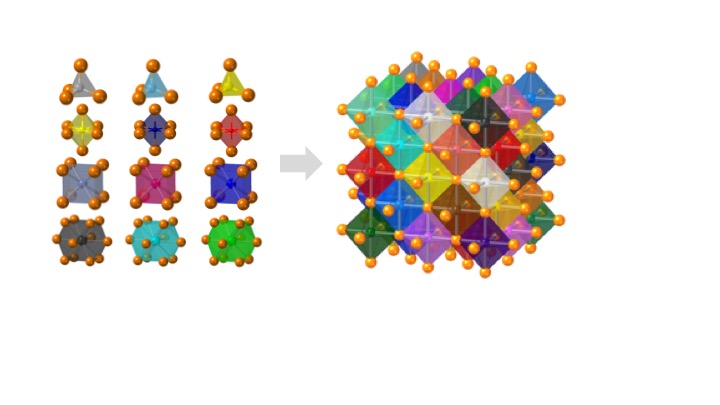
Crystals with high configurational entropy, engineered through chemical formulation, exhibit unique composition-structure-property combinations that are absent when chemical order prevails. These high-entropy materials follow unexpected crystal chemistry rules and hold promise for new functional properties. IRG2 endeavors to identify and understand these rules through an integrative effort linking theory, synthesis, characterization, and computation. The hypothesis driving this research is that high configurational entropy leads to high solubility for atoms in “misfit” local environments, which produces a spectrum of local energies and disordered geometries that collectively generate new macroscopic responses. The IRG seeks to understand how local structures relate to specific formulations and how short-range disorder couples over longer length scales. With this understanding, we will uncover the predictive rules for high-entropy crystal chemistry.
IRG2 is organized into four interwoven thrusts. Three of these are property-driven and endeavor to understand:
How electronic and ionic transport can be maximized in high-entropy perovskites and fluorites
How local distortions can influence global symmetry and polar ordering in high-entropy perovskites with disorder on both cation sublattices
How electron correlation and magnetism manifest in high-entropy rock salts and pyrochlores.
In each case we explore the limits of misfit cations in a parent high-symmetry structure, where the misfits are chosen so as to influence property evolution. An overarching multiscale theory and modeling effort couples to machine learning to predict structure, defect chemistry, and properties in all materials of interest. At small length scales first-principles calculations model and predict the entire landscape of local distortions in particular formulations and link them to local properties such as ion migration barrier, defect formation energy, band structure, and polarizability. First-principles data feeds phase-field and stochastic models at higher length scales to connect formulation, local structure, electronic structure, and crystal structure to cooperative responses, and microstructures.
IRG 1: 2D Polar Metals and Heterostructures
IRG1 2D Polar Metals and Heterostructures pursues the promise of a new materials platform that stabilizes a diverse array of two-dimensional polar metals and enables their integration into ground-breaking optically and electronically active heterostructures.

Metals and alloys sit at the heart of materials research, but their susceptibility to surface oxidation has impeded their investigation in atomically thin form or as pristine surfaces exposed to the ambient environment. Thus, metals are generally not considered to be electrostatically gateable, rarely strongly polar, and typically not straightforward constituents of complex quantum hetero-structures due to interfacial reactions. IRG1 surmounts these challenges and opens up new areas of fundamental science and application for metals and their alloys through in-situ encapsulation and heterostructure formation that takes advantage of the protected high-energy interface underneath epitaxial graphene and exploits a self-healing effect that yields air-stable atomically thin crystalline metals that are also polar, with exceptional nonlinear optical response and intriguing potential for impacts in quantum devices and biosensing.
The IRG converges expertise in synthesis, optics and spectroscopy, transport, spintronics, device engineering, biosensing, theory and data-driven computation to exploit the unique opportunities in fundamental science and application afforded by air-stable crystalline 2D metals and alloys. These efforts will be accelerated by predictive computation to guide synthesis and application within the expansive compositional design space that CHet endows, and will open new routes to Quantum Leap, enable new sensing modalities for elucidating the Rules of Life, and provide an intriguing venue to Harness the Data Revolution. The team's efforts are organized around quantum and optical property domains, tied together by a central thrust in synthesis of novel structures, compositions and heterostructures of air-stable polar 2D metals.
IRG II: Non-Equilibrium Phenomena in Mechanically Soft Systems
This IRG is pursuing new insights into the behavior of mechanically soft systems that are subjected to perturbations far from equilibrium. By combining data-rich experiments, theory, and artificial intelligence, the research will contribute greatly to NSF's 10 Big Ideas: Harnessing the Data Revolution by expanding its application to soft materials. While our focus is on soft materials, the insights gained will be broadly applicable to other classes of materials, spanning a wide range of length and time scales.
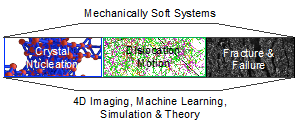
Figure 1. IRG 2 goals
To carry out the research, we bring together a multidisciplinary research team composed of faculty members from applied mathematics, biology, physics, chemistry, earth and planetary science, soft matter physics, and mechanical engineering with deep expertise in soft materials assembly (Lewis, Weitz, Whitesides), fracture mechanics (Holbrook, Rice, Suo), 4D confocal imaging and materials characterization (Spaepen, Vlassak), machine learning and computer simulation (Brenner, Colwell, Denolle, Frenkel, Kozinsky), and theory (Nelson) to focus on three goals that exploit data-driven science (Figure 1).
Understand crystal nucleation in single and multi-component hard-sphere systems and use the knowledge gained to develop new routes for creating alloys.
Investigate collective dislocation motion that underlies plastic deformation of materials.
Explore fracture phenomena in mechanically soft systems to understand their toughening, dissipation, and failure mechanisms.
Showing 941 to 950 of 2653