IRG I: Programmable Multiscale and Multi-Material Control of Functional Matter
This IRG is aimed at fundamental advances in materials synthesis, modeling, and 3D printing that enable the creation of functional soft materials that augment human performance. New classes of soft materials that sense, actuate, and communicate are being developed for use in wearables, haptic interfaces, and artificial muscles connecting to NSF's 10 Big Ideas: Future of Work at the Human-Technology Frontier.
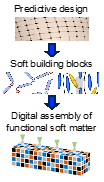
Figure 1. IRG 1 goals
To carry out the this research, we bring together a multidisciplinary research team composed of faculty members from applied mathematics, bioengineering, chemistry, materials, and mechanical engineering with deep expertise in theory and computation (Bertoldi, Kozinsky, Mahadevan, Rycroft, Suo), synthesis and assembly (Aizenberg, Clarke, Lewis, Parker, Vaia, Weitz), and characterization (Bertoldi, Clarke, Pindak, Suo, Walsh) to focus on three intertwined goals (Figure 1).
Establish predictive design rules that guide the synthesis and digital assembly of soft functional materials across multiple scales.
Synthesize soft building blocks composed of functional elastomers with controlled network architecture and stimuli-responsive moieties for creating soft functional materials.
Create functional soft matter via digital assembly that sense, communicate, and actuate in response to external stimuli for potential application at the human-technology interface.
IRG 1: Materials Science of Quantum Phenomena in van der Waals Heterostructures
IRG 1, Materials Science of Quantum Phenomena in van der Waals Heterostructures, combines two-dimensional van der Waals materials into pristine layered heterostructures. Under an existing MIRT program, this team has demonstrated successful collaboration to develop proof-of-concept heterostructures with unprecedented size, perfection, and complexity, giving us the ideal building blocks for the current effort.
This IRG focuses on three research thrusts:
Expanding the class of available materials, particularly using synthetic methods that produce large-area films;
Measuring and controlling the properties of atomically thin vdW materials in a protected, ultralow-disorder environment; and
Creating new interfaces that exhibit emergent electronic phenomena.
IRG 2: Controlling Electrons, Phonons, and Spins in Superatomic Materials
IRG 2, Controlling Electrons, Phonons, and Spins in Superatomic Materials, assembles new classes of functional materials using precisely defined superatom building blocks coupled together with new forms of inter-superatom bonding. This approach will combine encoding of desirable physical properties within the building blocks with exquisite control of inter-superatom interaction, to create materials with tunable properties and multiple functionalities.
This IRG will develop and expand the superatom concept into a large "periodic table" to enable designer materials with unprecedented levels of complexity and functionality. It will initially focus on three materials areas:
Materials with independent control over magnetism and conductivity.
Materials with independent control over thermal and electrical transport properties.
Superatom assemblies that can have electronic phase transitions that may be induced by optical, mechanical, thermal, and other stimuli.
SUNY Stony Brook MRSEC - Polymers at Engineered Interfaces (1996)
his Materials Research Science and Engineering Center (MRSEC) at the University of New York at Stony Brook supports research in the area of polymer thin films at engineered interfaces. The MRSEC is a collaborative activity between researchers at a number of institutions in the New York metropolitan area, including Brookhaven National Laboratory, Polytechnic University, Queens College, Lehman College, and two industrial research and development centers. The research is carried out in one interdisciplinary research group. The focus of the Center is the design of polymer thin film properties through precise control of interfacial structure. A central goal of the Center is to address technological problems related to polymer thin films, and to develop cutting-edge enabling technologies that take existing polymeric systems and markedly improve their properties. The MRSEC supports the development, operation and maintenance of shared experimental facilities for materials research. It provides seed funding for exploratory research and emerging areas, and fosters research participation by undergraduates. The MRSEC has strong industrial links and an educational outreach program from the pre-college to the graduate level. The Center currently supports 12 senior investigators, 3 postdoctoral research associates, 10 graduate students, and 6 undergraduates. The MRSEC is directed by Professor Miriam Rafailovich. %%% This Materials Research Science and Engineering Center (MRSEC) at the University of New York at Stony Brook supports research in the area of polymer thin films at engineered interfaces. The MRSEC is a collaborative activity between researchers at a number of institutions in the New York metropolitan area, including Brookhaven National Laboratory, Polytechnic University, Queens College, Lehman College, and two industrial research and development centers. The research is carried out in one interdisciplinary research group. The focus of t he Center is the design of polymer thin film properties through precise control of interfacial structure. A central goal of the Center is to address technological problems related to polymer thin films, and to develop cutting-edge enabling technologies that take existing polymeric systems and markedly improve their properties. The MRSEC supports the development, operation and maintenance of shared experimental facilities for materials research. It provides seed funding for exploratory research and emerging areas, and fosters research participation by undergraduates. The MRSEC has strong industrial links and an educational outreach program from the pre-college to the graduate level. The Center currently supports 12 senior investigators, 3 postdoctoral research associates, 10 graduate students, and 6 undergraduates. The MRSEC is directed by Professor Miriam Rafailovich.
IRG 2: Topology and Fractionalization in Magnetic Materials
Topology, best understood for weakly interacting electrons, implies robust protection ofelectronic properties. Magnetism, on the other hand, arises fundamentally from strong interactions. An urgent and tantalizing question is whether topological protection can arise in magnetic systems, since achieving precise control over the magnetic properties of solids is a long-standing problem with critical applications for both spintronics and quantum information. IRG-2 seeks to establish a new paradigm for topological phases in strongly correlated magnetic materials.
IRG-2’s materials synthesis and crystal growth programs will generate a new class of magnetic materials for the condensed matter community, with great potential impacts on science and our national competitiveness.
New algorithms and software developed within this proposal to search for topological magnetic materials will be internet accessible, leading to improvements in the computer-aided design of materials in physics, chemistry, and materials communities.
All members of IRG-2 will engage fully in CEM diversity and outreach programs. Valdés-Aguilar, the CEM REU Director and Bridge Program steering committee member, and Trivedi, the faculty lead of the Scientific Thinkers program, will take leadership roles. Also, during the course of the work, they plan to include these topics in a CEM organized international conference.
UPENN Materials Research Science and Engineering Centers (2005)
The University of Pennsylvania Materials Research Science & Engineering Center (MRSEC) will build on past success and embrace new faculty to pursue a program to integrate the design, synthesis, characterization, theory & modeling of materials. These materials range from hybrid macro-molecules and de novo proteins, with architectures & functions inspired by nature, to nano- and micro-structured hard & soft materials with unique properties. Potential practical outcomes are in the areas of drug delivery, energy transduction, electronics, sensors, and cellular probes. The MRSEC research is organized around five Interdisciplinary Research Groups (IRGs), which target new advanced materials with potential for high-technology applications in diverse areas such as energy transduction, electronics, sensors, & cellular probes. Materials interfaces are a recurrent theme, as is the interplay between biological & synthetic constructs and composites of hard & soft materials. The MRSEC sustains an array of education and human resources development programs, whose impact will range from K-12 students and their teachers to undergraduates and faculty at minority serving institutions. It is associated with the University of Puerto Rico at Humacao through a Partnership for Research and Education in Materials (PREM). The MRSEC manages extensive shared facilities that benefit the broader research community. The MRSEC is linked with Penn's Center for Technology Transfer to license its discoveries and inventions for translational research thereby ensuring the coupling of MRSEC research to the needs of society.
The MRSEC contains the following IRGs: Filamentous Networks and
Structured Gels, IRG-1 explores the properties of filamentous networks with a goal to design & synthesize responsive network materials. Functional Cylindrical Assemblies, IRG-2 will synthesize semi-flexible, functional cylinders, composed of dendrimer-based polymers & self-assembling block copolymers. Synthetic Programmable Membranes, IRG-3 draws expertise from four departments to design fully integrated functional analogues of cellular membranes. De Novo Synthetic Protein Modules for Light-Capture & Catalysis, IRG-4 draws on the rich biological resource of atomic-level structures and functional mechanisms to guide design & synthesis of novel proteins as modular nano-scale materials. Oxide-based Hierarchical Interfacial Materials, IRG-5 will harness expertise in theory, synthesis, & experiment, from four departments to create and understand novel hierarchical interfacial oxide materials.
IRG-1: Spin-Photonic Nanostructures
Functional Liquid Crystalline Assemblies, Materials and Interfaces
By addressing fundamental issues related to soft, LC-based materials on multiple length scales via the integration of complementary experimental and theoretical tools, IRG 3 provides a foundation of knowledge with broad potential for impact on the design of hierarchical and active soft materials. Key fundamental issues IRG 3 investigates include the equilibrium and the non-equilibrium, dynamic behaviors of molecules at interfaces of anisotropic soft materials, interfacial ionic phenomena in LC systems, dynamic mechanical and transport properties of several classes of LC gels, including concepts of molecular frustration and surface-driven ordering transitions, and the structure and energetics of the cores of LC defects, including cores that host adsorbates. The challenge of designing these complex LC material systems is addressed by IRG 3 through the development of new experimental techniques, multi-scale theory and simulation, and new methods of synthesis and processing.
Functional Heteroanionic Materials via the Science of Synthesis
This IRG develops new heteroanionic materials with tunable electronic, ionic, thermal, and optical properties, which are otherwise inaccessible from simpler homoanionic structures and chemistries. Discovery of heteroanionic materials are facilitated by synthetic and characterization methods that provide a panoramic view of crystallization and diffusion processes in which emerging phases of interest are revealed and growth mechanisms are delineated. By emphasizing synthesis as the central science, the tools, protocols, and databases formulated in IRG-2 enable synthesis-on-demand of complex materials suggested by computational discovery.
Showing 951 to 960 of 2653