IRG 2: Bioinspired Engineering of Condensed Protein Mesophases and Cell Collectives
Atomic Membranes as Molecular Interfaces
 IRG Senior Participants:
Paul McEuen (co-leader, Phys), Jiwoong Park (co-leader, C&CB), Garnet Chan (C&CB), Harold Craighead (A&EP), Richard Hennig (MS&E), Jeevak Parpia (Phys), Keith Schwab (Phys), Michael Spencer (E&CE)
Collaborators: N. Sepulveda-Alancastro (U. of Puerto Rico at Mayag??ez), K. Ekinci (Boston Univ.), P. Kim (Columbia Univ.), B. Lane (Analog Devices), M. Zalalutdinov (NRL)
IRG Senior Participants:
Paul McEuen (co-leader, Phys), Jiwoong Park (co-leader, C&CB), Garnet Chan (C&CB), Harold Craighead (A&EP), Richard Hennig (MS&E), Jeevak Parpia (Phys), Keith Schwab (Phys), Michael Spencer (E&CE)
Collaborators: N. Sepulveda-Alancastro (U. of Puerto Rico at Mayag??ez), K. Ekinci (Boston Univ.), P. Kim (Columbia Univ.), B. Lane (Analog Devices), M. Zalalutdinov (NRL)
Our group is exploring the properties of atomic membranes: mechanically robust, freestanding films of material as thin as a single atom. The prototypical example is graphene, a single sheet of graphite. We are examining the mechanical, thermal, optical, and electronic properties of this novel material, as well as studying the effect of individual defects and adsorbates on it. In addition, we are using these membranes as an atomically thin interface between different environments, such as gas/vacuum or liquid/gas. This unprecedented ability to put different phases in nanoscale proximity, separated by only an atomically-thin wall, makes possible a wealth of new nanoscale measurements.
Hybrid Organic-Inorganic Nanoelectronic Materials from Molecules to Printable Thin Films
The primary objective of IRG-4 is to improve fundamental understanding, optimize process efficiency, and enable novel technological advances across multiple length-scales of hybrid organic-inorganic materials for nanoelectronic applications. Two major themes organize the group's efforts to realize new design principles and paradigms for electronic materials.
Materials Design: IRG-4 integrates theory and experiment to develop deep understanding of structure-electronic property relationships from the molecular scale to the macro scale. This understanding is employed to advance and optimize organic conductors and dielectrics and open up new vistas in the design of hybrid materials for nanoelectronic applications.
Materials Integration: IRG-4 pursues fundamental chemical and structural understandings of the interfaces between organic and inorganic materials including nanowires, nanotubes, and graphene, leading to advances in interface engineering and processing that are enabling for novel hybrid materials and technologies.
Accomplishments include:
- The theoretically guided design and synthesis of new organic high dielectrics and inorganic semiconductor nanowire heterostructures.
- Processing of single-walled carbon nanotubes into metallic transparent conducting contacts and semiconducting thin film transistors.
- Integration of molecular semiconductors, organic dieletrics, and inorganic nanowires into printable electronics.
- Spatially resolved electrical characterization of inorganic nanowires correlated with atomic-scale dopant mapping.
- New theories of non-equilibrium transport and quantum electronic structure of molecular materials and molecules at interfaces.
Dynamics of Novel Self-Assembling Protein-Polymer Hydrogels
Hydrogels are extensively used in medical applications and they are an important class of biomaterials that are under significant study for regenerative medicine applications. They are cross-linked, three-dimensional, hydrophilic polymer networks that can swell but not dissolve in water. Hydrogels derived from biological macromolecules such as proteins and polysaccharides are of great interest to the biomedical community as they can contain intrinsic biological information or serve as an extracellular matrix mimic. The study of the properties of functional and responsive hydrogels presents a fundamental challenge with important practical applications. What are the molecular factors that determine the structure of the gel? What is the activity of specific ligands within the gel? How do pH sensitive groups respond within the network structure? In order to study these complex systems we are carrying out a combined experimental and theoretical effort aimed at the fundamental understanding of the mechanism of formation and properties of hydrogels formed by mixtures of proteins and polymers. We have developed a novel family of water-soluble poly(diol citrates) that can mediate the formation of a protein gel via complexation. Protein-polymer gels with water content of up to 90% have been fabricated with bovine and human serum albumin, fibrinogen, and hemoglobulin without covalently modifying the protein. The gels can form within 10 minutes, depending on the protein and temperature of the gelation and degrade within 4 to 8 weeks. The overall objectives of this project include the understanding at the fundamental level of the driving forces for the formation of this class of hydrogels, the mechanism of gel formation and the identification of design criteria that would allow the formation of the protein gels for tissue engineering applications. Toward this goal, we are using a combination of theoretical studies and experimental observations to investigate the formation and properties of the gels as well as the feasibility of using these protein gels for controlled release of proteins and cell encapsulation. The results of this research will lead to a new paradigm on the mechanism for protein gel formation and protein delivery.
Organic Thin-film Bipolar Junction Transistors (Seed 2)
Among common semiconductor devices are the diode, field effect transistor, and bipolar junction transistor (BJT). Thin-film analogues of the first two exist and enable commercial products, such as flexible displays and thin-film solar cells. The thin-film BJT has, however, been elusive. Inorganic semiconductor processing steps for deposition and doping required for BJTs are ill-suited for making thin-film BJTs. On the other hand, the ability to deposit organic semiconductor films at low temperature, control their thickness down to the nm range, engineer interfaces with well-defined energy structures, and chemically dope the films should allow for fabricating and demonstrating a thin-film BJT.
The Seed 2 project aims at investigating the interplay between doped organic molecular films, with the ultimate goal of fabricating and testing p-n type heterojunctions that are central to an organic BJT. Central issues for the realization of molecular BJTs are the controlled n- and p-type doping of the emitter, base and collector sections of the device, and the transport of carriers via diffusion through the base. Carrier transport in molecular films is negatively impacted by disorder-, defect- and impurity-induced electronic traps and tail gap states, which decrease mobility and act as recombination centers. In our project, chemical n- and p-doping not only serves to establish the p-n-p (or n-p-n) structure of a BJT, but is also used to passivate, or de-activate, these traps and gap states, thereby improving transport.
Principal Investigators
Barry Rand (Electrical Engineering)
Antoine Kahn (Electrical Engineering; Engineering and Applied Science)
* This seed is inactive.
Nanoparticle-Based Materials
 Nanoparticle-based Materials. The vision of IRG-4 is to explore nanoparticle-based materials that are non-toxic, environmentally benign, abundant, stable and economically manufacturable, and to understand their fundamental optoelectronic properties for luminescent and photovoltaic (solar-to-electric energy conversion) applications. The IRG focuses on semiconductor nanoparticles including group IV materials (Si and Ge) and several metal-oxides, whose constituent elements are among the most abundant in the earth's crust and non-toxic. IRG researchers study the size-tunable optical properties of nanoparticles, novel low-cost nanoparticle assembly approaches, and novel photo-physical phenomena in nanoparticles and nanoparticle films.
Michigan State University Materials Research Science and Engineering Center (1994)
The Materials Research Science and Engineering Center (MRSEC) at Michigan State University provides a focal point for long-range university-based research on materials and devices that have high potential for application in automotive sensing systems. The MRSEC contains two strongly focused interdisciplinary research groups. The group investigating chemically tailored materials for automobile control and diagnostics integrates efforts in chemistry, physics and engineering to develop chemically tailored materials that can provide engineers with new devices and techniques for the development of improved automobiles. The research targets specific sensing applications related to engine performance, which is largely determined by the fuel composition entering the engine and its turbulent mixing in the cylinder. A newly developed technique, LIPA (laser induced photochemical anemometry) is used to provide real-time maps of cylinder gas flows in test chambers or actual engines. The group investigating materials used for physical sensing in automobiles concentrates their studies on materials that are rugged, perform well in extremely variable and harsh conditions, and can be manufactured reliably and efficiently. The MRSEC supports a variety of shared facilities including a lithographic facility, space and services in a chemistry laser laboratory, space in the engine research and turbulent mixing laboratories, and the engineering research laboratories for film growth and fabrication. There is active industrial collaboration with Ford and General Motors. Educational plans for the MRSEC involve K-12 students in urban and rural schools, science and engineering undergraduates on campus, and interdisciplinary research participation by advanced degree candidates. The center currently supports 13 senior investigators, 2 postdocto ral research associates, 2 technical staff members, 12 graduate students, and 4 undergraduates. The MRSEC is directed by Professor Brage Golding.
Magnetic Intermetallic Mesostructures
Remarkable electrical, magnetic, and thermal phenonmena exist in functional intermetallics, and this richness stands to be amplified via multiscale microstructural design capable of further unlocking and harnessing their properties. Hierarchically structured thermoelectric materials with high figures of merit exemplify the power and promise of this multiscale approach. The materials challenge addressed in this IRG is to understand and develop unprecedented control over the couplings between strain, magnetization, and temperature (entropy) in single- and multiphase intermetallic compounds. The long-term outcome of this research will be design rules for novel intermetallics that display engineered magnetoelastic and magnetocaloric responses to external fields, which will provide a fundamental advance capable of impacting technologies of actuation and solid-state refrigeration.
IRG 1: Creation and Control of Metal/Magnetic-Insulator Interfaces
The development of novel magnetic systems enabling fast, efficient control of magnetic states is essential to advancing next-generation spin-electronics. IRG-1 is exploring a highly promising approach utilizing little-explored magnetic structures founded on insulating magnets and innovative means of controlling spins. This multidisciplinary team will establish a new regime for the creation and understanding of novel static/dynamic magnetic phases and multipronged control of the magnetic states in interface-driven metal/magnetic insulator systems.
Goals:
This IRG will advance the development of MI interfacial platforms, provide insights into the charge and spin dynamics down to the fs/as time scales, and achieve novel control of the magnetic states, which will be made available to the research community.
The team brings together diverse, multidisciplinary expertise including atomic-molecular-optical and condensed matter physics, chemistry, and materials sciences and engineering, to provide a rich collaborative environment in which graduate, undergraduate students, and postdocs perform cutting-edge, team-based research. CEM students and postdocs will benefit tremendously from this center-wide community, in which they develop collaboration and leadership skills.
IRG-1 members have a strong record of actively engaging students from underrepresented minority groups in research, including those from OSU, the REU program, and community colleges. IRG-1 PIs play important roles in the OSU Physics Bridge Program in recruiting and advising the Bridge students. The supportive and collaborative environment within CEM will help Bridge students overcome the barriers in course work and research and improves their sense of belonging.
Structure and Dynamics in Confined Polymers (IRG 2)
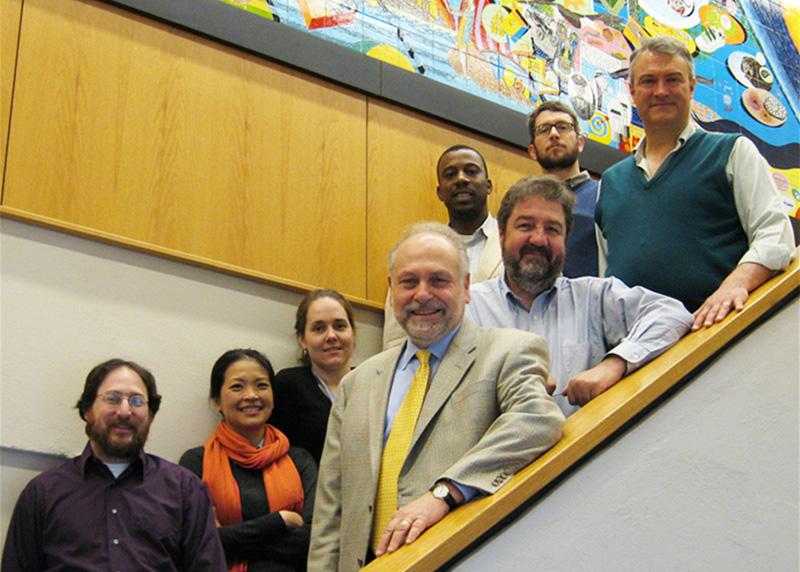 IRG-2 seeks to combine novel experiments with theory to understand the fundamental principles underlying the dramatic property deviations of amorphous polymers when confined to the nanoscale, and to uniquely exploit size and interfaces for advanced materials design. In the former, we aim to understand the combined roles of size, interfaces and processing on the behavior of confined amorphous polymers by developing novel processing routes through which different states of confinement can be achieved and subsequently characterized by state-of-the-art, in-house custom built instruments. For example, a unique gas-phase deposition process, MAPLE (Matrix Assisted Pulsed Laser Evaporation), will be exploited for innovative materials design of heterogeneous amorphous films and their nanocomposites. The interplay between novel processing methods and confining geometries as well as novel characterization tools combined with rigorous simulation and theory carried out in an integrated approach is the hallmark of IRG-2. The insights learned from the work will provide an important contribution to the general understanding of the glass transition, and a demonstration of how that knowledge can be applied for the development of new materials, for instance, stable glasses.
Co-Leaders
R. D. Priestley (CBE, co-leader)
C. B. Arnold (MAE, co-leader)
Senior Investigators
Y.-L. Loo (CBE)
C. P. Brangwynne (CBE
P. G. Debenedetti (CBE)
C. E. White (CEE)
A. Z. Panagiotopoulosv (CBE)
R. A. Register (CBE)
Collaborators
G. Fytas (MPI)
A. Bell (Promerus)
K. Tanaka (Kyushu U.)
H. Stone (Princeton U.)
Showing 961 to 970 of 2653