Highlights
Mar 14, 2008
University of Minnesota - Twin Cities
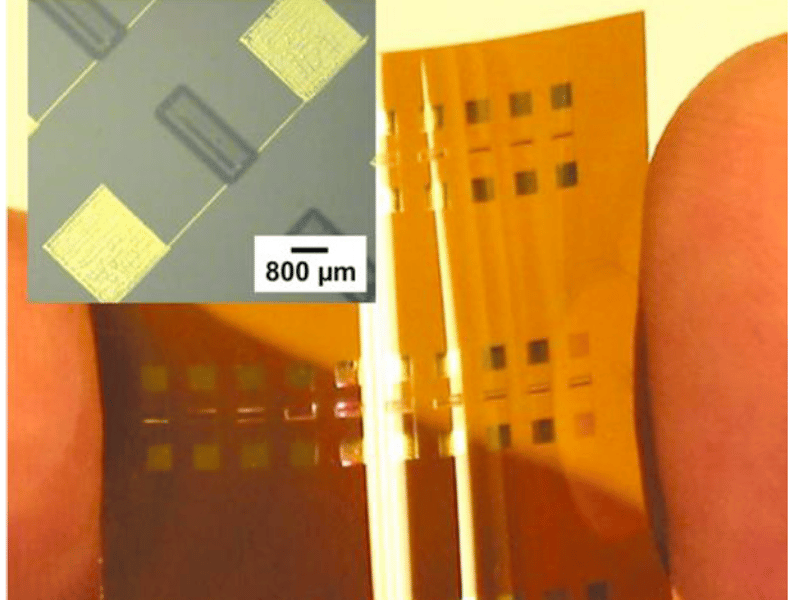
Printed Organic FETs on Plastic
In a collaboration with an industrial manufacturer of aerosol jet printers (Optomec, Inc.), Lodge, Frisbie, and their students have demonstrated successful low voltage operation of an array of ion-gel gated OFETs printed on flexible polyimide substrates. Every component of the OFETs was printed--the metal electrodes (gold colloidal ink), the semiconductor (poly(3-hexylthiophene), and the gate insulator (the new ion gel material).
Mar 14, 2008
University of Minnesota - Twin Cities
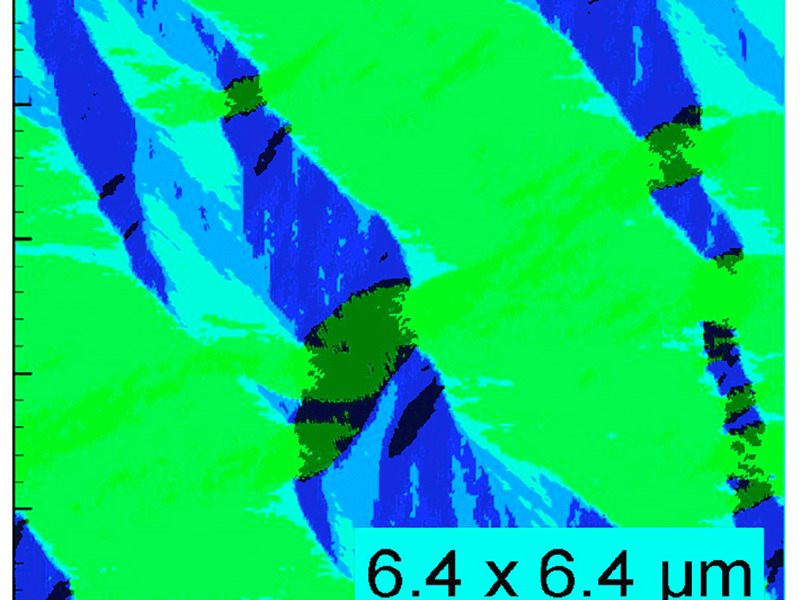
Understanding Magnetic "Exchange Pinning"
Magnetic storage of digital data is now possible at densities approaching 1 Terabit per square inch at a cost of only about a tenth of a cent per Megabit. To a large extent, the breathtaking progress in this area of technology is sustained by discovery of bits. The invention of “GMR" sensors based on stacks of ultra-thin films of magnetic metals (for which the Nobel Prize in Physics was awarded in 2007) is a perfect example.
Mar 6, 2008
Princeton University
PCCM Helps Integrate Materials Science into NJ School Curricula
Daniel Steinberg, Rick Register, Jim Sturm, Craig Arnold, Ilhan Aksay
In 2004, PCCM launched a partnership with ASM to run a week-long "Materials Camp" for high school teachers. Over the past four years, over 120 teachers have been trained to teach materials science in local schools. In follow-up evaluations and refresher sessions, teachers report in using this knowledge in their classrooms.
Feb 25, 2008
Massachusetts Institute of Technology
Dynamic Surface-Emitting Fiber Lasers
John Joannopoulos (MIT), Yoel Fink (MIT)
Members of of IRG-I have recently introduced a new concept in fiber lasers. Until now, emission from fiber lasers originated solely from the fiber ends in the axial direction with a spot size dictated by the core radius. In contrast, these novel lasers, termed surface-emitting fiber lasers (SEFLs), emit radiation radially and are capable of dynamic tuning of both the gain-medium position along the fiber axis and the direction of emission.These interesting results suggest that the direction of the laser beam can be controlled remotely just by rotating the pump polarization.
Feb 25, 2008
Massachusetts Institute of Technology
Dual Function Drug-Release Coating Mimics Hummingbird Wings
Anne Mayes (MIT), Michael Rubner (MIT)
Functionally active thin film coatings find many important uses in the biomedical field as sensors and drug delivery systems. Members of IRG-II have created a new multilayer coating that can serve both functions. By creating a patterned multilayer stack comprised of alternating regions of low refractive index (nanoporous regions) and high refractive index (dense regions), the coating exhibits bright iridescent colors similar to those observed in, for example, hummingbird wings (see Figure below).
Feb 22, 2008
University of Washington
GEMSEC Partnership with a Community College for Curriculum Development
To create a nationally replicable model of a sustainable and continuously up-gradable hands-on undergraduate teaching laboratory of scanning probe methods, GEMSEC is working with researchers from the UW's Center for Nanotechnology, educators from North Seattle Community College, representatives from a scanning probe microscopy manufacturer, and a nanotechnology SPM distributor. This partnership, NUE UNIQUE, will inaugurate a new paradigm of initiating, operating, and maintaining a SPM laboratory to serve entire classes of undergraduate students with a student to instrument ratio of ~3:1.
Feb 22, 2008
University of Washington
Multi-faceted Education and Partnerships at GEMSEC
With a particular focus on engaging and including Native Americans in its entire range of programs, GEMSEC is weaving a fabric of education offerings to seamlessly support and complement its research thrusts.
Feb 22, 2008
Princeton University
Self-Assembly of Soft Materials: A Multiscale Computational Approach
Seed and IRG 2: Maria Sammalkorpi, Mikko Haataja, and Athanassios Panagiotopoulos
Surfactant adsorption at solid-liquid interfaces is important in many industrial processes, including corrosion inhibition, dispersion stabilization, and lubrication. Furthermore, surfactant adsorption may provide novel and exciting means to guide soft materials to self-assemble into a myriad of tailored shapes. Recently, PCCM researchers have made a breakthrough in elucidating the physical mechanisms behind surfactant self-assembly on a graphite surface [1].
Showing 1301 to 1310 of 1452