Highlights

Low temperature properties of glass and its connection to glass stability
May 17, 2022
Big Idea: Harnessing the Data Revolution, Machine Learning / Artificial Intelligence, Quantum Leap

Low temperature properties of glass and its connection to glass stability

Clare Yu, University of California, Irvine; Bu Wang, University of Wisconsin-Madison

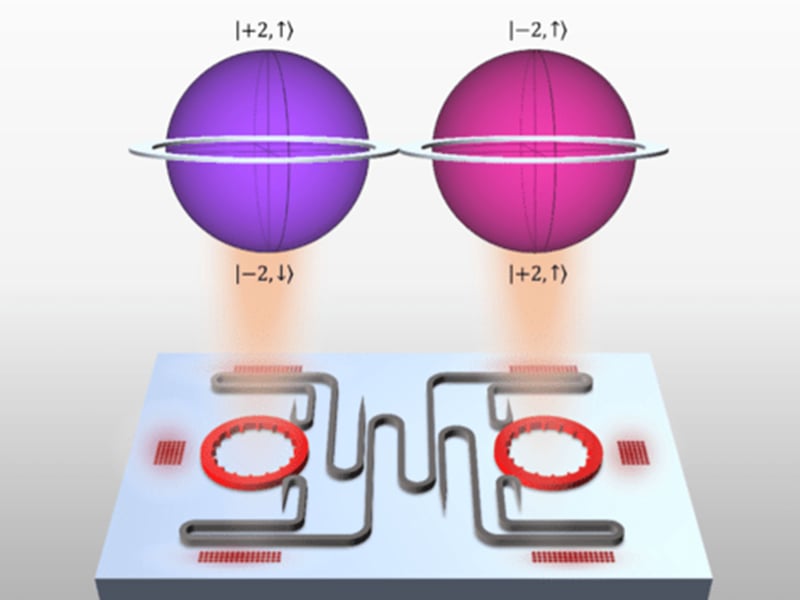
Wisconsin MRSEC IRG 1 developed a new theory describing how sound waves couple two level systems together. Experiments using a superconducting qubit measured the coupling of many TLS, one at a time, and showed that they are consistent with the theory. Machine learning applied to simulations identified the atomic arrangements associated with TLS and showed that as the glass grows more stable, the TLS density decreases.
Top:  A custom chamber interfacing a laser beam for selective laser melting and an IR camera. Bottom left: Thermal image of CoNi powders at a uniform temperature during temperature calibration. Bottom right: Calibrated emissivity of CoNi powders as a function of temperature.
Top: A custom chamber interfacing a laser beam for selective laser melting and an IR camera. Bottom left: Thermal image of CoNi powders at a uniform temperature during temperature calibration. Bottom right: Calibrated emissivity of CoNi powders as a function of temperature.
May 16, 2022
University of California, Santa Barbara

Understanding thermal effects on the microstructure of additive manufactured materials

Temperature has been shown to be a critical factor impacting additive manufacturing (AM). During selective laser melting (SLM), the heat transfer and fluid flow affect grain growth and the microstructure of the printed material. Previous efforts have mostly relied on tuning parameters such as laser power and scan rate, but a more detailed understanding of temperature effects in AM is still lacking. In this Seed, we will probe and understand how dynamic and localized heating and cooling affect the microstructure of additive manufactured (AM) materials by operando temperature mapping and machine learning.
Top: Examples of printed structures with complex geometries. Bottom: Internal structures before (left) and after (right) heating, showing the thermal activation of microporosity.
May 16, 2022
University of California, Santa Barbara

Three-Dimensional Photochemical Printing of Thermally Activated Polymer Foams

S.E. Seo, Y. Kwon, N.D. Dolinski, C.S. Sample, J.L. Self, C.M. Bates, M.T. Valentine, C.J. Hawker (UC Santa Barbara)

This work demonstrates the facile, on-demand manufacturing of polymer foams with desirable properties such as mechanical strength, controlled porosity, and varied composition.
Left: Schematic of swell shark and egg casing. Right: Inset shows hierarchical nanostructures that deform under stress.
May 16, 2022
University of California, Santa Barbara

Nanolatticed Architecture Mitigates Damage in Shark Egg Cases

R. Goh, S.P.O. Danielsen, E. Schaible, R.M. McMeeking, J.H. Waite (UC Santa Barbara)

Structure-mechanics analysis of shark egg cases has revealed that dynamic reorganization of the nanolatticed architecture provides strength and resilience without compromising permeability.
3D-printing aligned collagen reveals that this scaffold does not direct mammary gland branching.
These zwitterionic electrolytes promote ion transport through a pathway of vacancies. This transport mechanism enables performance that exceeds the literature (squares) when analyzed in the selectivity-conductivity design space.
May 16, 2022
University of California, Santa Barbara

Zwitterionic Electrolytes Enable Decoupling of Ionic Transport from Segmental Relaxation

Ionic transport in polymers typically undergoes a standard liquidlike transport mechanism whereby diffusion of ions is permitted only by relaxation of the local fluid elements, this mechanism results in limitations in designing conductive and cation-selective electrolytes. In this work we demonstrate that superionic transport (untethered to polymer dynamics) is possible in semicrystalline poly(zwitterionic liquids).
Additively manufactured Alnico magnets and 3D microstructure generated using TriBeam tomography.
May 16, 2022
University of California, Santa Barbara

Microstructural evolution in additively manufactured magnetic materials

Rottmann, Polonsky, Francis, Emigh, Krispin, Rieger, Echlin, Levi, Pollock (UC Santa Barbara)

Samples of Alnico magnets were printed by selective laser melting, and their microstructure was investigated in 3D at the mm3-scale using the femtosecond-laser enabled TriBeam microscope.
Twisted bilayer WTe2: a Moiré Luttinger Liquid in Two-Dimensions
Multiscale computational design approach to identify magnetic alloys with prescribed properties.
May 16, 2022
University of California, Santa Barbara

Tuning magnetic antiskyrmion stability in tetragonal inverse Heusler alloys

Kitchaev, Van der Ven (UC Santa Barbara)

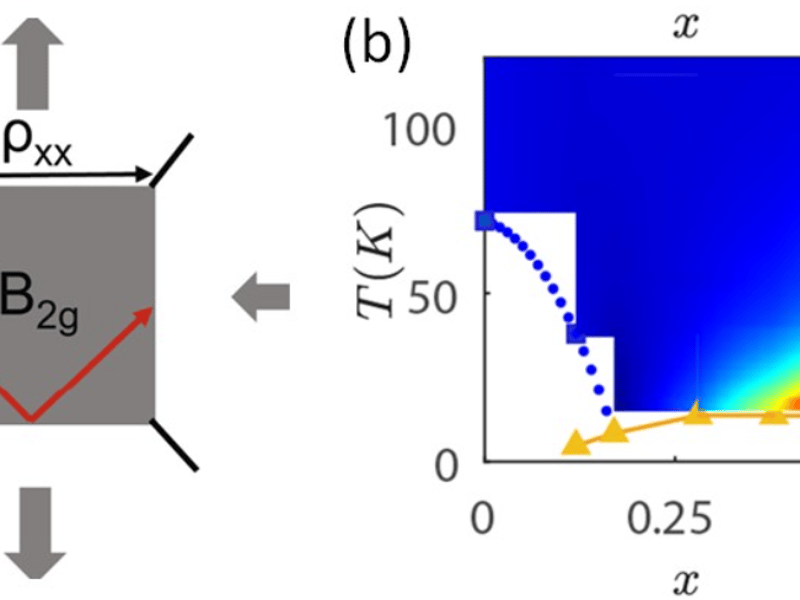
A computational approach was implemented to design Mn2XY tetragonal inverse Heusler alloys that host magnetic antiskyrmions whose stability are sensitive to elastic strain.
Enhancing lithium-ion transport in solid-state polymer electrolytes using electron-deficient imidazole ligands. Our study indicates that steric and electronic ligand properties are critical for enhancing lithium-ion diffusion and transport.
May 16, 2022
University of California, Santa Barbara

Electron-Deficient Imidazoles in Solid-State Polymer Electrolytes

Andrei Nikolaev, Peter M. Richardson, Shuyi Xie, Luana Llanes, Seamus D. Jones, Hengbin Wang, Rachel A. Segalman, Raphaële J. Clément, and Javier Read de Alaniz  (UC Santa Barbara)

Solid-state polymer electrolytes offer a safer alternative to traditional lithium-ion batteries based on organic electrolytes. However, current benchmark polymer electrolytes lack ion transport selectivity (t+ = 0.2) which limits their commercial use. We demonstrate the enhancement of lithium-ion transport (t+ = 0.48) of PMS-based polymers by taking advantage of the steric and electronic properties of imidazole ligands.