Highlights

(Top) Experimental setup (left) and map of creep strains within the sandpile measured via Diffusive Wave Spectroscopy (DWS) (right). At the moment of preparation and up to 11 days after pouring (right), spatially-heterogeneous creeping motions appear within the pile. (Bottom) Heat perturbations reset the creep rate and the timescale of relaxation (left) while tapping reduces the creep rate, and confines deformation to the free surface (right)
Aug 3, 2021
University of Pennsylvania

The Perpetual Fragility of Creeping Hillslopes

Douglas J. Jerolmack, Paulo E. Arratia, & Robert A. Riggleman, University of Pennsylvania

Soil is a highly disordered granular material. Slow soil deformation (creep) controls the shape of hills in the natural landscape, and is a precursor of catastrophic landsliding. Our work demonstrates a surprising observation: an apparently static sandpile, sitting on a table, is actually alive with motion. We study a 3D granular heap, confined by walls and prepared by pouring. Via Diffusive Wave Spectroscopy (DWS), we observe the existence of spatially-heterogeneous micro-deformations that decay in size and frequency as time progresses but persist up to 11 days after the preparation of the system; the heap relaxes. We find that this relaxation can be enhanced  (overaged) or reversed (rejuvenated) by tuning the types of disturbances applied to system.
Surface Modification of Black Phosphorus with Group 13 Lewis Acids for Ambient Protection and Electronic Tuning
Jun 3, 2021
Big Idea: Quantum Leap

Surface Modification of Black Phosphorus with Group 13 Lewis Acids for Ambient Protection and Electronic Tuning

Alexandra Velian and Mo Li Molecular Engineering Materials Center (MEM-C) University of Washington, Seattle

We have developed a solution-phase protocol to modify the Lewis basic surface of few-layer black phosphorus (bP) using commercially available Lewis acids, and demonstrated its effectiveness at providing outstanding ambient stability and tuning of electronic properties.
Tunable Correlated and Topological States in Twisted Graphene Multilayers
Jun 3, 2021
Big Idea: Quantum Leap

Tunable Correlated and Topological States in Twisted Graphene Multilayers

David Cobden, Xiaodong Xu and Matthew Yankowitz Molecular Engineering Materials Center (MEM-C) University of Washington, Seattle

Stacking various atomically-thin crystals on top of one another can strongly modify their overall properties. When two materials are stacked with a twist angle, a geometric interference pattern (a moiré pattern) emerges. At special twist angles, the moiré pattern can result in new electronic states dominated by strong correlations between electrons.
PCCM Holiday Lecture 2020: "A Materials Wonderland: A Celebration of How Materials Science Make Our Holidays Fun
May 18, 2021
Princeton University

Holiday Lecture 2020: A Materials Wonderland

PCCM celebrated its annual Holiday Lecture 2020: A Materials Wonderland: A Celebration of How Materials Science Make Our Holidays Fun with PCCM faculty, research members and others providing (virtual) materials science presentations. The audience helped with experiments and demonstrations from their homes. 426 families registered, some with multiple children (tuning from all over the world), resulting in ~1,000 attendees!
A team led by Princeton physicists discovered a surprising quantum phenomenon in an atomically thin insulator made of tungsten ditelluride. The results suggest the formation of completely new types of quantum phases previously hidden in insulators. Image source: Image designed by Kai Fu for the Wu Lab, Princeton University
May 18, 2021
Big Idea: Quantum Leap

Discovery of Intrinsic Landau Quantization in an Insulator

P. Wang1*, G. Yu1*, Y. Jia1*, M. Onyszczak1, F. A. Cevallos1, S. Lei1, S. Klemenz1, K. Watanabe2, T. Taniguchi2, R. J. Cava1, L. M. Schoop1, S. Wu1, Nature 589, 225–229 (2021) 1 Princeton University, USA 2National Institute for Materials Science, Tsukuba, Japan

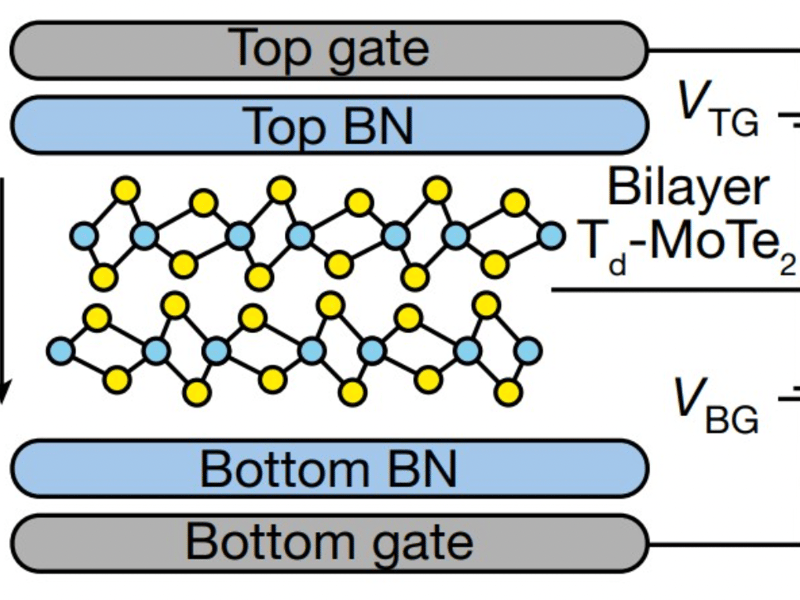
In a surprising discovery, Princeton physicists have observed an unexpected quantum behavior in an insulator made from a material called tungsten ditelluride. This phenomenon, known as quantum oscillation, is typically observed in metals rather than insulators, and its discovery offers new insights into our understanding of the quantum world. The findings also hint at the existence of an entirely new type of quantum particle.
Multi-qubit Entanglement in a Quantum Network
Sculpting and Predicting Flows in Active Nematics
Metallic “Defect Wires” in aSemiconducting Oxide
May 17, 2021
UMN Materials Research Science and Engineering Center

Metallic “Defect Wires” in a Semiconducting Oxide

H. Yun; M. Topsakal; A. Prakash; B. Jalan; J.S. Jeong; T. Birol; K.A. Mkhoyan

Semiconductors, which have electrical properties in between metals and insulators, are the building blocks of devices like transistors that fuel computer technology. New semiconducting materials that could outperform existing ones are continuously sought in science and engineering, with oxides being one contender. In recent work in the University of Minnesota MRSEC, researchers studying one such oxide semiconductor - barium tin oxide - made the startling discovery of a completely new type of “line defect”.
PointNet-meso: A Tool for Detecting Self-Assembled Block Oligomer Morphologies Image source: Z. Shen; Y. Z. S. Sun; T. P. Lodge; J. I. Siepmann
May 17, 2021
Big Idea: Machine Learning / Artificial Intelligence

PointNet-meso: A Tool for Detecting Self-Assembled Block Oligomer Morphologies

Z. Shen; Y. Z. S. Sun; T. P. Lodge; J. I. Siepmann

Screening block oligomer chemistry and architecture through molecular simulations to find promising candidates for functional materials requires effective morphology identification techniques. Common strategies for structure identification include structure factors and order parameters, but these fail to identify imperfect structures in simulations with incorrect system sizes.
Trainable shear memory in dense suspensions
May 17, 2021
Big Idea: Understanding the Rules of Life

Trainable shear memory in dense suspensions

H. Kim*, G. L. Grocke, H. Zhang, S. N. Patel, S. J. Rowan, H. M. Jaeger, manuscript in preparation.           *Joint postdoc in Jaeger & Rowan labs **All at the University of Chicago

A collaboration between the University of Chicago MRSEC groups of Jaeger, Patel, and Rowan showed that the complex modulus of a dense suspension of microparticles can be increased exponentially over several orders of magnitude by applying interval training during oscillatory shear, leading to a structural memory.