Highlights

Heteroanionic Fluoride Doping in Indium Oxide Semiconductors
Apr 25, 2022
Big Idea: Harnessing the Data Revolution

Heteroanionic Fluoride Doping in Indium Oxide Semiconductors

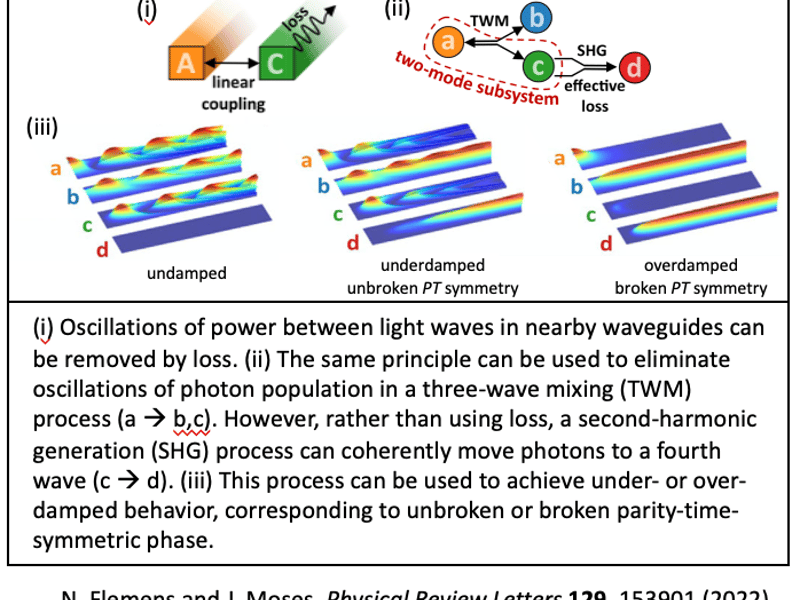
This work represents the first study to establish fluoride as a universal amorphizing agent in the  indium oxide system, and by inference, may play a similar role in related oxide semiconductor materials.
Tuning Optoelectronic Properties with Mixed-Dimensional Heterostructures
Apr 25, 2022
Big Idea: Quantum Leap

Tuning Optoelectronic Properties with Mixed-Dimensional Heterostructures

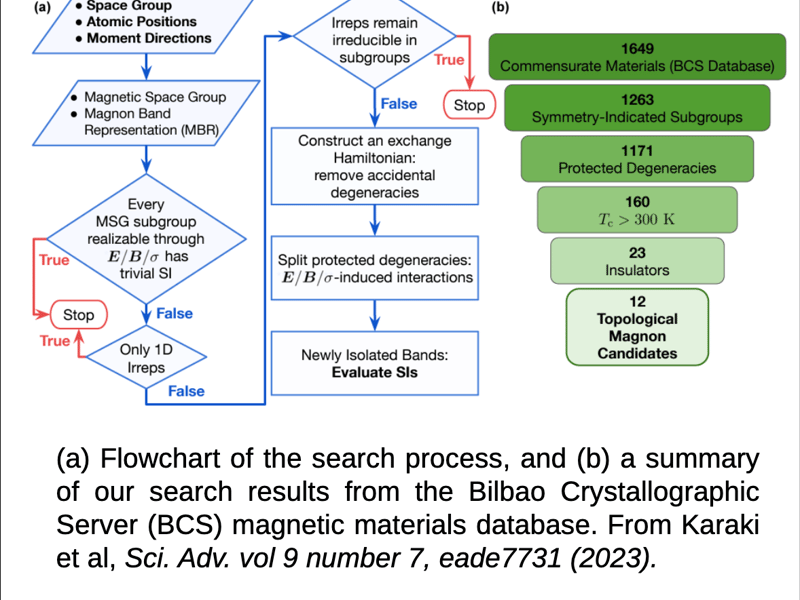
Lattice defects play an important role in determining the optical and electrical properties of monolayer semiconductors such as MoS2. Although the structures of various defects in monolayer MoS2 are well studied, little is known about the properties of the fluorescent defect species and their interaction with molecular adsorbates.
Leaders in Innovation:  New Startups Addressing Societal Problems
Leaders in Innovation: New Startups Addressing Societal Problems
Apr 6, 2022
Big Idea: Future of Work at the Human-Technology Frontier

Leaders in Innovation: New Startups Addressing Societal Problems

The Harvard MRSEC provides a vibrant culture of entrepreneurship and several recent Ph.D. students supported by Center IRGs and seed projects have co-founded new companies. 
(A) Design principle to achieve diverse deformation trajectories: misalignment of molecular anisotropy (M), microstructure geometry (G), and light (L). (B) Formation of a transient propagating bimorph in a single material by directional light-activation with a stationary light source. (C) Upon irradiation from opposite sides, the same microstructure displays mirrored right- and left-handed curved stroke-like trajectories, which are captured by FE modeling. (D) Spontaneous self-organization of strings of microposts into an undulating line. Modeling results on the right. (E) Simulation and experimental results of X-shaped jointed compositionally uniform microactuators exhibit twisting/rotation of the stem and amplified sway motion of the horizontal arms.
Apr 6, 2022
Big Idea: Future of Work at the Human-Technology Frontier

Self-Regulated Non-Reciprocal Motions in Liquid Crystal Elastomer Pillars

A team at the Harvard MRSEC led by Bertoldi and Aizenberg has developed an approach to achieve a diverse trajectories from a single-material system via self-regulation: when a photoresponsive liquid crystal elastomeric pillar with mesogen alignment is exposed to light, it ‘dances’ dynamically as light initiates a traveling order-to-disorder transition front that twists and bends via opto-chemo-mechanical feedback.
MRSEC collaborations celebrate diversity and professional growth in materials research
Dec 23, 2021
University of Delaware

MRSEC collaborations celebrate diversity and professional growth in materials research

K. Bothi, T. Epps, III, L. Korley University of Delaware MRSEC DMR-2011824

UD CHARM and Princeton’s PCCM coordinated with the Chicago MRSEC to host three virtual events (Soft Matter for All, Rising Stars, and a Professional Development Workshop) to highlight early career, high-impact research and ignite discussion for graduate students and postdocs pursuing academic and non-academic career paths.
Spin-to-charge conversion in ferromagnet/ topological insulator bilayers at GHz and THz frequencies
Dec 23, 2021
University of Delaware

Spin-to-charge conversion in ferromagnet/ topological insulator bilayers at GHz and THz frequencies

B. Jungfleisch, L. Gundlach, A. Janotti (University of Delaware) and G. Bryant (NIST) University of Delaware MRSEC DMR-2011824

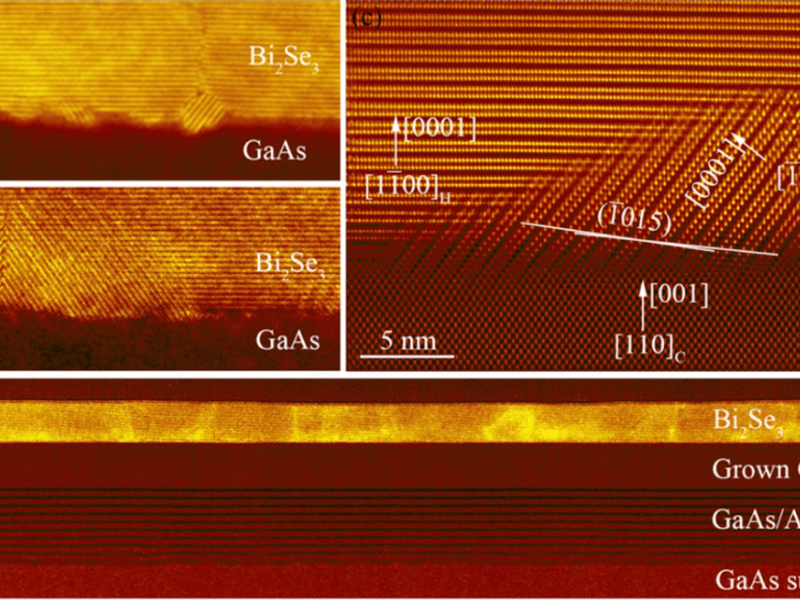
Experimental studies combined with theoretical calculations of spin dynamics across a wide frequency range from ~10 GHz to several THz in a novel amorphous ferromagnet (FM)/3D topological insulator (TI) (FeGaB/BiSb) system that is scalable and provides a promising platform for spin-electronic devices.
Deformation and Orientational Order of Chiralmembranes with Free Edges
Deformation and Orientational Order of Chiral membranes with Free Edges
Nov 29, 2021
Brandeis University

Deformation and Orientational Order of Chiral membranes with Free Edges

L. Ding,  R. A. Pelcovits,  T. R. Powers: Brown University Z. Dogic: Brandeis University, UCSB  

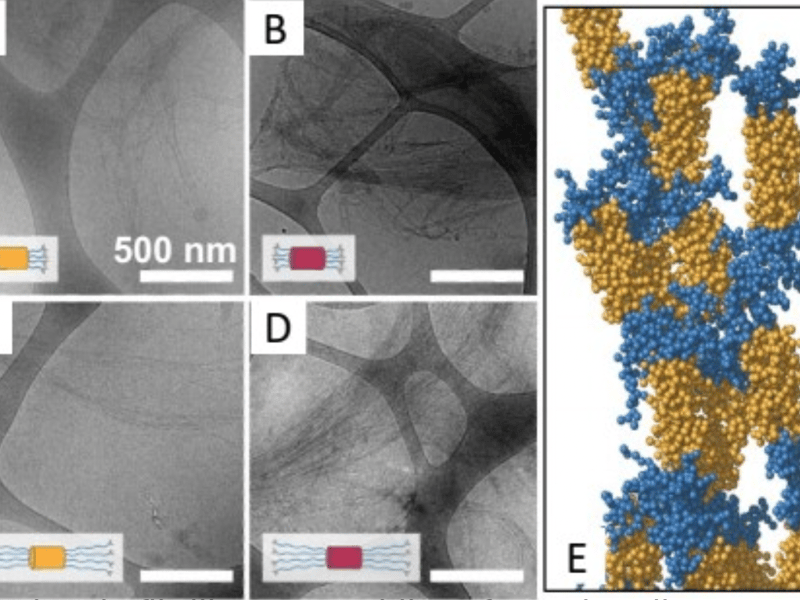
Producing self-assembled structures of prescribed limited size and shape is a major challenge in nanoscience. A major achievement of the MRSEC was to elucidate a new chirality-based mechanism that leads to self-limiting assembly of colloidal rafts.
Confinement Controls the Bend Instability of Three-Dimensional Active Liquid Crystals
Nov 29, 2021
Brandeis University

Confinement Controls the Bend Instability of Three-Dimensional Active Liquid Crystals

G. Duclos, A. Baskaran: Brandeis University Z. Dogic: Brandeis University, UCSB

Here, three IRG2 PP developed a combination of experiments with 3D active fluids confined in microfluidic channels and a minimal hydrodynamic model to show that size of the channel determines the emergent lengthscale of the growing deformations. These findings will advance our understanding of active nemato-hydrodynamics and the pathways to 3D active turbulence at low Reynolds number.
During fibrosis, collagen fibers become denser and aligned.  Engineered fibrous matrices now respond to mechanical loading to densify and align fibers through inter-fiber adhesion.
During fibrosis, collagen fibers become denser and aligned. Engineered fibrous matrices now respond to mechanical loading to densify and align fibers through inter-fiber adhesion.
Aug 3, 2021
University of Pennsylvania

Fibrous Networks in Liver Fibrosis

Rebecca Wells, Jason Burdick, Vivek Shenoy, University of Pennsylvania

Animal  tissues are composed of cells attached to either the surface of a fibrous network called a basement membrane or embedded within a 3D extracellular or interstitial matrix. As the disease liver fibrosis progresses, the extracellular fibrous networks become denser and more aligned. These physical changes lead to different mechanical properties and structures to which cells are exquisitely sensitive. To better understand the pathological effects of these changes during fibrosis on cells, we have engineered material platforms that mimic the extracellular matrix in tissue health and disease. As an example, we have fabricated fibrous materials that have varied mechanical properties and fiber densities when mechanically loaded due to the chemical adhesion between fibers, similar to natural extracellular matrix (see Figure).
The molecular clutch model (top) of mechanotransduction explains the effect of matrix viscoelasticity on cell spreading. Simulations predict optimal cell spreading when the timescale for stress relaxation (τs) is similar to the clutch binding timescale (τb).
Aug 3, 2021
University of Pennsylvania

Effects of extracellular matrix viscoelasticity on cellular behavior

Paul Janmey, Vivek Shenoy, University of Pennsylvania

Linearly elastic elastomers coated with matrix proteins are widely used to assess the role of stiffness. Such experiments are often assumed to reproduce the effect of the mechanical environment experienced by cells in vivo. However, tissues and the extracellular matrix (ECM) are not linearly elastic materials. They exhibit far more complex mechanical behaviors. These behaviors include viscoelasticity, as well as mechanical plasticity, and nonlinear elasticity. Our theoretical and experimental work has revealed that matrix viscoelasticity regulates fundamental cell processes and can promote behaviors – such as proliferation, motility and spreading – that are not observed with elastic hydrogels in both two- and three-dimensional culture microenvironments.