Highlights
May 15, 2025
Center for Hybrid, Active, and Responsive Materials
FORGES: Foundations for Recruitment of Great Engineers and Scientists, Summer STEM Exposure Program
Gwen Gregory, Joseph Madanat, Allie Landry, John Jungck, Jon Manon University of Delaware
FORGES is a summer program aimed at high school students interested in STEM careers. In partnership with the University of Delaware, the program offers hands-on experiences in materials science, chemistry, biology, and physics. Activities included identifying polymers, measuring material properties, and performing gene editing techniques. After the program, 87% of students felt more confident about attending college, and all participants were more inclined to pursue STEM careers and felt better prepared for laboratory work.
May 14, 2025
The Bioinspired Soft Materials Center
Symmetry-guided inverse design of self-assembling multiscale DNA origami tilings
D Hayakawa1, TE Videbæk & WB Rogers (Brandeis University), GM Grason (U Mass Amherst)
Researchers developed new design techniques for creating complex two-dimensional patterns using triangular units that fit together based on specific chemical interactions. By leveraging symmetry, they designed crystal structures with many different subunit types, which could help advance technologies in light manipulation. Experiments with DNA origami confirmed the effectiveness of these designs, producing patterns with sizes comparable to visible light. The study also identified cost-effective design principles to streamline future work in this area.
May 14, 2025
The Bioinspired Soft Materials Center
Solid-to-liquid transition in contractile active matter
Duclos, Baskaran, Hagan, & Fraden (Brandeis University) Dogic (UCSB)
Researchers combined experiments and computer simulations to uncover why contractile asters, made of biopolymers, slow down in coalescence and can have liquid or solid traits. They identified the reasons for asters becoming solid and created new ways to form liquid-like asters. Additionally, other studies looked at how actin filaments affect the movements of these asters. This work helps fill in knowledge gaps about the behavior of these structures in living systems.
May 14, 2025
UMN Materials Research Science and Engineering Center
Mesoscopic Morphologies in Frustrated ABC Bottlebrush Block Terpolymers
F. S. Bates, T. P. Lodge (IRG-2)
Researchers at UMN MRSEC have explored the self-assembly of ABC bottlebrush block terpolymers, which could lead to new material designs. Unlike traditional diblock bottlebrushes, these new structures showed interesting formations like core-shell cylinders and an unusual rectangular pattern. They found that by changing the molecular weight, they could achieve a variety of sizes. This work opens up exciting possibilities for creating materials with unique structures and sizes for uses in photonic crystals and metamaterials.
May 14, 2025
UMN Materials Research Science and Engineering Center
Pushing the Limits of Topotactic Cycling Endurance in Oxide Electrochemical Transistors
K. A. Stoerzinger (Seed), C. Leighton, V. E. Ferry (IRG-1)
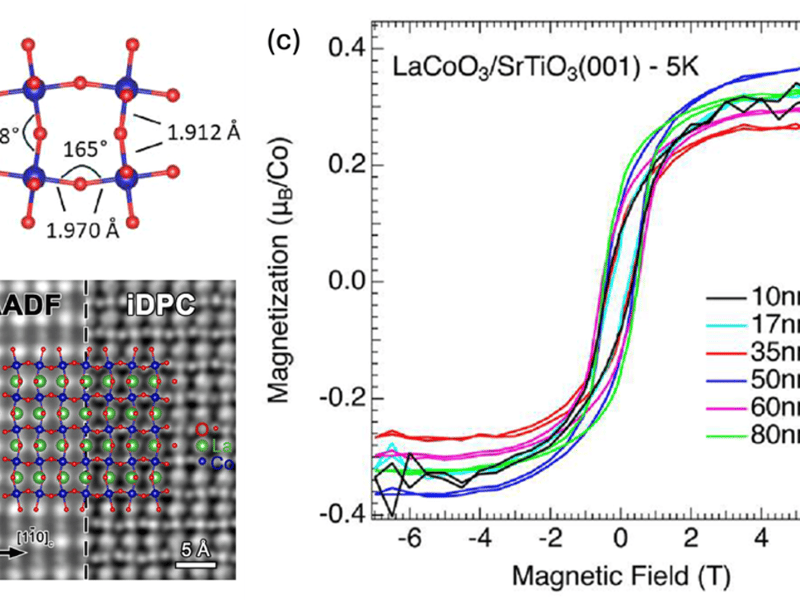
Recent research on oxide electrochemical transistors from the UMN MRSEC has significantly improved their performance, particularly in cycling endurance. A collaboration led to record durability in ion-gel transistors using La0.5Sr0.5CoO3-d (LSCO), enhancing previous limits drastically. By applying operando FTIR spectroscopy, researchers gained insights into the factors affecting performance, such as humidity and device design. These advancements open up potential uses for LSCO in areas like thermal camouflage and thermoregulation.
May 14, 2025
UChicago Materials Research Center
Chiral active solids with life-like properties
IRG-2: Vitelli group
Researchers developed active solids made of centimeter-scale building blocks that can move and adapt in different environments. These prototypes show unique elasticity, which allows them to change their movement patterns and navigate various terrains effectively, similar to complex robotic systems. This study highlights the potential of these materials to link robotics and material science and suggests new ways to control dynamic systems in nature and technology.
May 14, 2025
UChicago Materials Research Center
Dense suspensions as trainable rheological metafluids
Heinrich Jaeger & Stuart Rowan (UChicago)
A recent study by Hojin Kim and Samantha Livermore shows that dense suspensions can be trained to respond differently to stress levels, similar to how living organisms train for better performance. By applying shear stress, these materials can develop “memories” that affect their mechanical properties, becoming either stiffer or softer with repeated impacts. This innovative approach suggests potential applications for materials that can adapt and change their viscosity or energy dissipation on demand.
May 14, 2025
Center for Emergent Materials
Co-based metal-organic frameworks as spin liquid candidates
Prof. Yiying Wu, Jos Heremans, Nandini Trivedi, Yuanming Lu (OSU), Sara Haravifard (Duke)
Researchers have created a new cobalt-based metal-organic framework that shows potential for hosting a Kitaev spin liquid. This material features cobalt ions in a honeycomb arrangement, linked together by benzoquinone, which creates a special type of magnetic frustration. By adjusting the linkers' chemical composition, the strength of the magnetic interactions can be varied. While magnetization tests indicated antiferromagnetic interactions, no spin ordering was found at low temperatures, highlighting this framework's potential in exploring spin liquid physics.
May 14, 2025
Center for Emergent Materials
Sharp signatures of fractionalized excitations in Kitaev spin liquids
Prof. Nandini Trivedi, The Ohio State University
Researchers have theoretically shown that distinct signs of Majorana excitations can be found in the Kitaev honeycomb model when a perpendicular magnetic field is applied. These unique features appear in what are called two-spin-flip excitations. The findings suggest that techniques like nonlinear THz spectroscopy could help detect these signatures in materials that are being studied as spin liquids. This work advances the understanding of quantum matter in these complex systems.
May 14, 2025
Center for Emergent Materials
Quantum Sensing of Spin Dynamics Using Boron-Vacancy Centers in Hexagonal Boron Nitride
P. Chris Hammel, Fengyuan Yang (OSU), Jyoti Katoch, Simranjeet Singh (CMU)
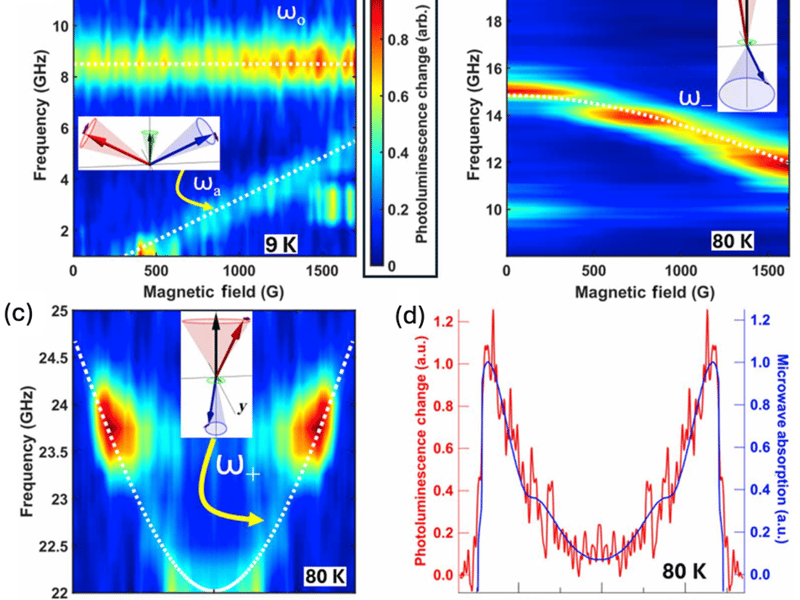
A recent study showcased how boron-vacancy centers in hexagonal boron nitride can be used for quantum sensing. These defects allow for the detection of weak magnetic fields through their spin-sensitive light emissions. The researchers demonstrated the capability to optically detect specific magnetic wave behaviors in materials like yttrium iron garnet. This work positions boron-vacancy centers as a flexible tool for exploring various magnetic phenomena in new material systems.
Showing 21 to 30 of 1394