Highlights
May 15, 2024
Big Idea: Quantum Leap
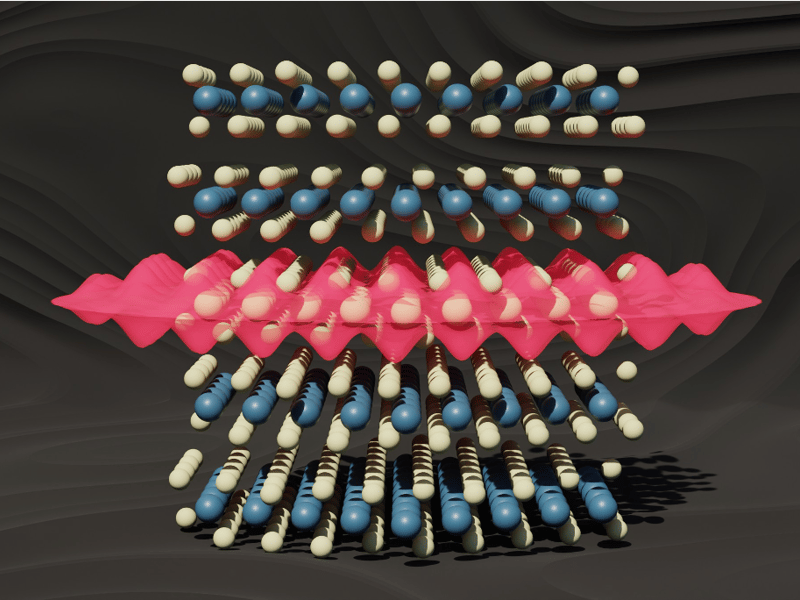
Endotaxial stabilization of 2D charge density waves with long-range order
Rather than the typical approach of exfoliating and peeling off individual atomic layers to make a 2D material, the researchers grew the 2D material inside of another matrix. The work has dubbed this new class of materials "endotaxial" from the Greek roots "endo", meaning within, and "taxis", meaning in an ordered manner.
May 15, 2024
Big Idea: Recyclable Plastics and Alternative Materials
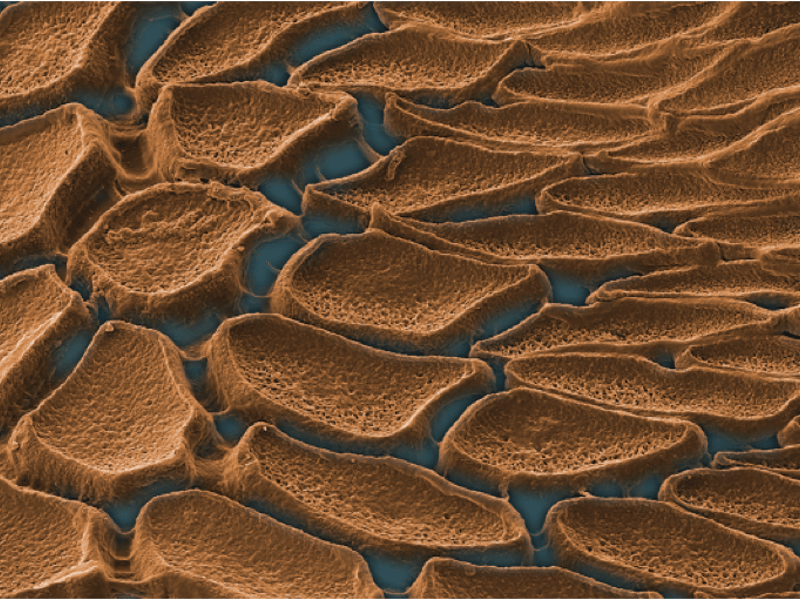
Thermomechanical Properties of Squid Sucker Proteins
This article studies the reversible structure and mechanical properties of a biological dynamic polymer network. This biological material based on structural protein polymers has a glass transition at 35 °C, causing a reversible thermomechanical transition and a change in modulus spanning several orders of magnitudes.
May 15, 2024
University of Washington
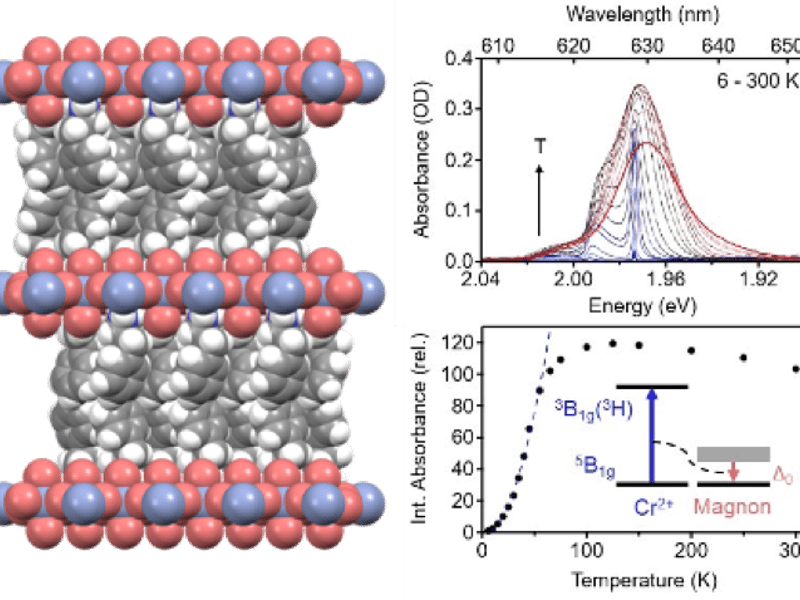
MEM-C IRG-1: Spin-Photonic Coupling in a Ferromagnetic Hybrid Layered Perovskite, (PEA)2CrCl4
The Cr2+-based compounds, A2CrX4, where A = M+ (e.g., K+, Cs+, Rb+) or RNH3+ (e.g., MeNH3+) and X = Cl-, Br-, are an underexplored family of lead-free layered metal-halide perovskites. These compounds attracted a great deal of interest in the 1970s and 1980s after their "transparent ferromagnetism" was discovered, but they have received virtually no attention since, perhaps because they are extremely unstable in air. Further investigation into their chemistry and properties is warranted.
May 15, 2024
University of Washington
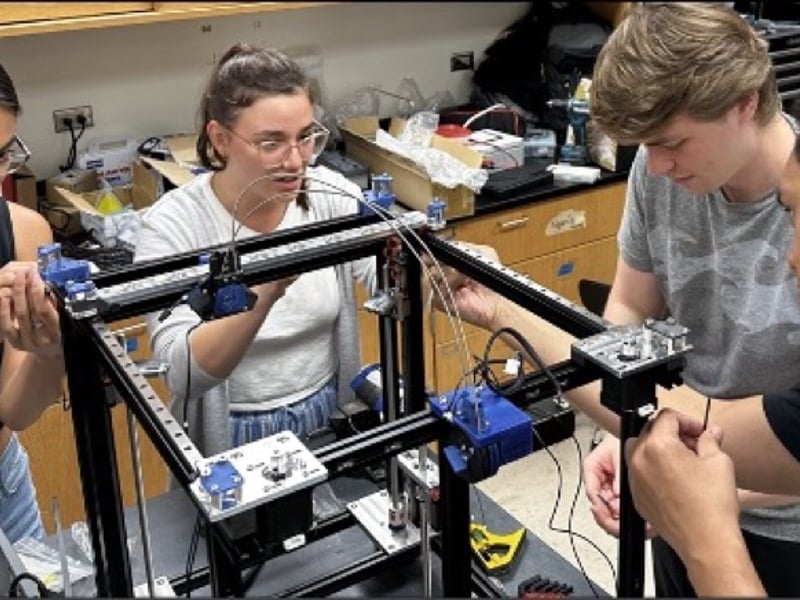
MEM-C SEED: Expanding Data Automation Using a Jubilee Robotic Platform
UW Chemical Engineering Prof. Lilo Pozzo’s ‘23/’24 Seed project aims to serve the materials community by advancing AI-driven experimentation and analysis for broad adoption and acceleration of materials research. Pozzo has engaged in highly collaborative projects to advance self-driving laboratory (SDL) technologies and to help others adopt them for their own workflows.
May 15, 2024
Big Idea: Harnessing the Data Revolution, Machine Learning / Artificial Intelligence
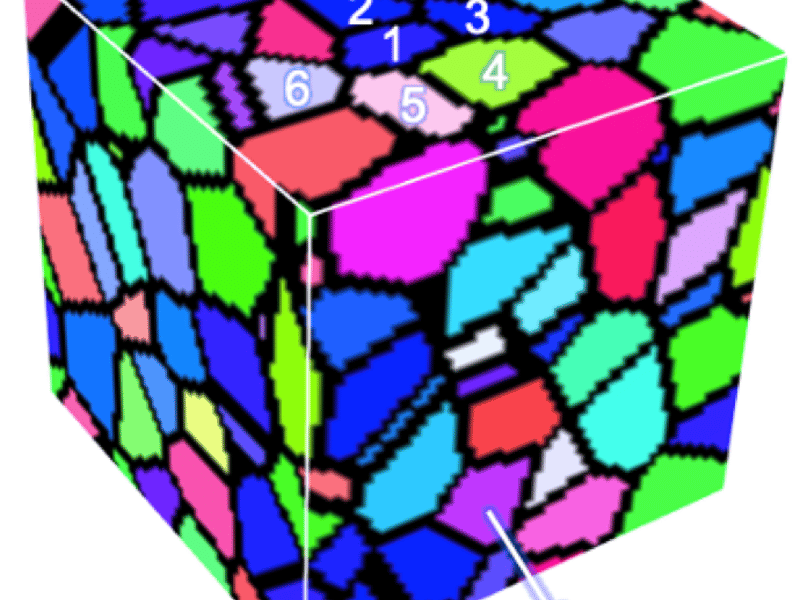
Graph Machine Learning for Polycrystals
Wisconsin MRSEC researchers have leveraged the power of machine learning to tame the complexity of polycrystalline materials and predict their properties. They have developed a graph neural network approach that predicts materials properties with >98% accuracy 90,000 times faster than competing methods. They applied this model to predict magnetostriction, which quantifies the size change of a material induced by a magnetic field.
May 15, 2024
University of Wisconsin - Madison
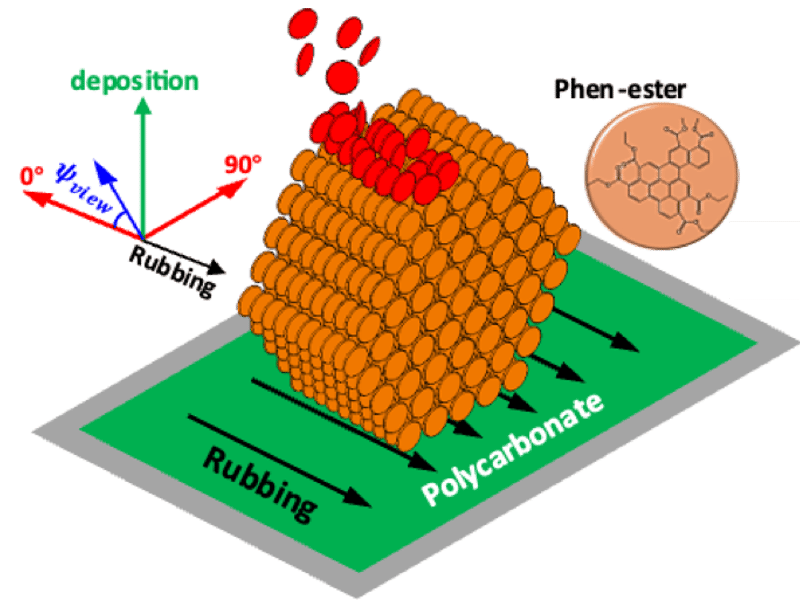
Biaxially-aligned Glasses of Organic Semiconductors
Researchers in the Wisconsin MRSEC have shown that depositing onto an alignment substrate creates better glass films that are anisotropic biaxially, meaning they are aligned in the plane of the substrate as well as out of plane. The in-plane orientation of the molecules affect how they interact with light and conduct electricity. In general, more alignment is better for applications ranging from flexible transistors to OLEDs to organic photovoltaics.
May 13, 2024
Big Idea: Harnessing the Data Revolution
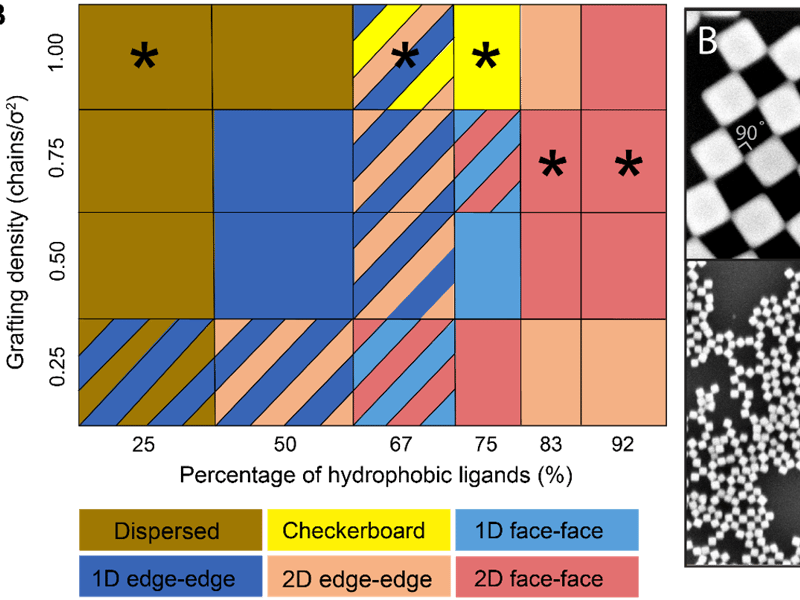
Self-assembly of nanocrystal checkerboard patterns
The UC San Diego team has achieved the assembly of checkerboard lattices from colloidal nanocrystals that harness the effects of multiple, coupled physical forces at disparate length scales (interfacial, interparticle, and intermolecular) and that do not rely on chemical binding. Colloidal Ag nanocubes were bi-functionalized with mixtures of hydrophilic and hydrophobic surface ligands and subsequently assembled at an air-water interface.
May 13, 2024
Big Idea: Recyclable Plastics and Alternative Materials, Synthetic Materials Biology
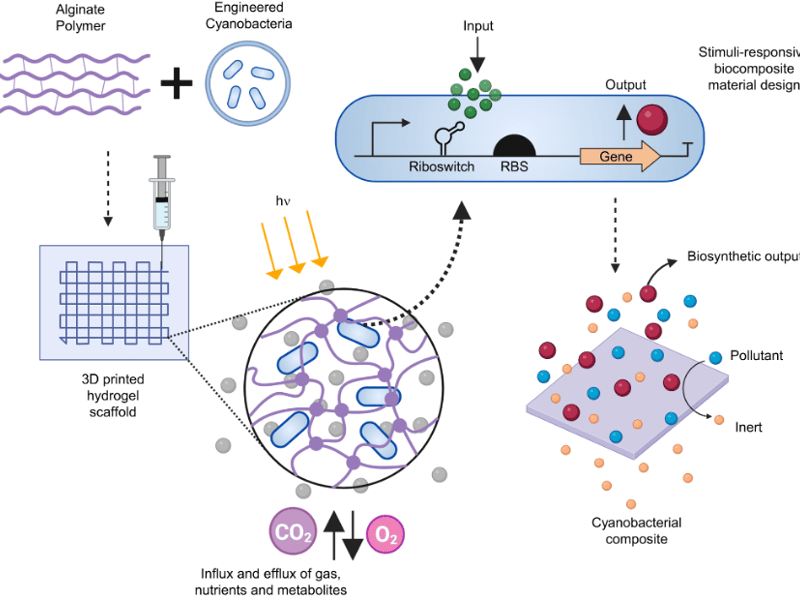
Cyanobacterial Composites Remediate Organic Pollutants
UC San Diego researchers developed and programmed cyanobacterial composite materials to remediate an organic dye pollutant.
May 10, 2024
University of Texas at Austin
Structure tunable optical properties in linked nanocrystal gels
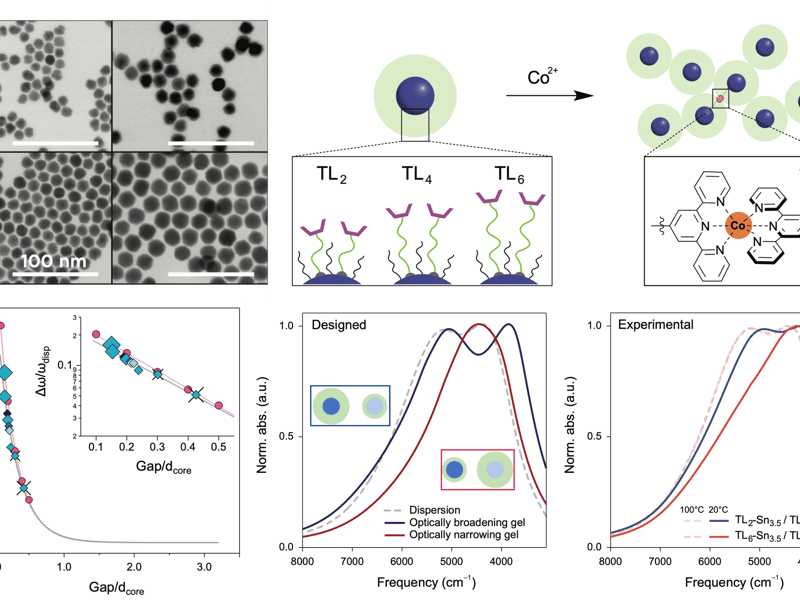
Optical properties of plasmonic ITO nanocrystal gels, assembled by thermoreversible cobalt terpyridine links, were tuned systematically based on the size and doping concentration of the nanocrystals and length of the custom ligand molecules. Correlation of optical shifts upon assembly with nanocrystal spacing deduced by small angle X-ray scattering was used to develop a universal structure-property relationship that was validated by large-scale optical simulations on gels made using Brownian dynamics simulations.
May 10, 2024
University of Texas at Austin
Nonlinear Rheological Behavior of Dynamic Covalent Gels
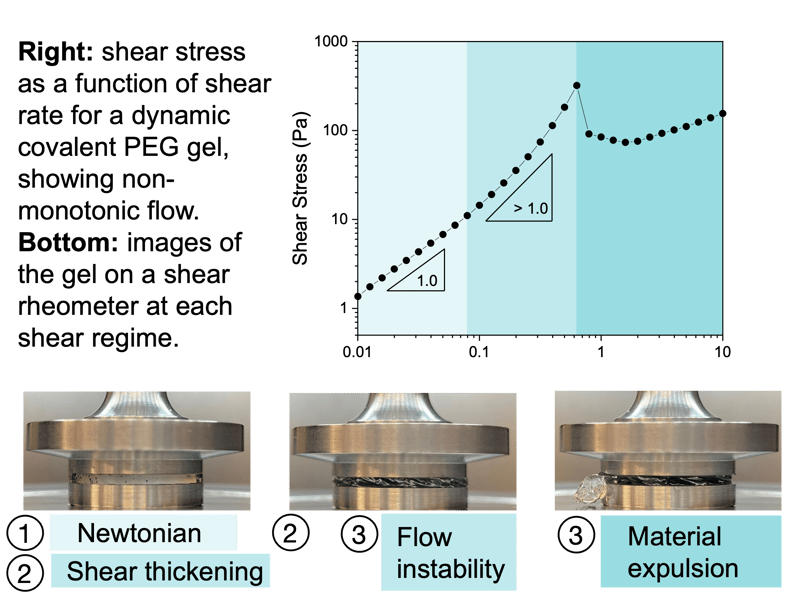
UT Austin researchers developed synthetic multi-arm poly(ethylene glycol) (PEG) hydrogels with three different dynamic covalent linking chemistries. They exhibit non-monotonic flow curves under steady shear, with shear thickening behavior that depends on the crosslinking bond exchange kinetics and polymer concentration.
Showing 141 to 150 of 1452